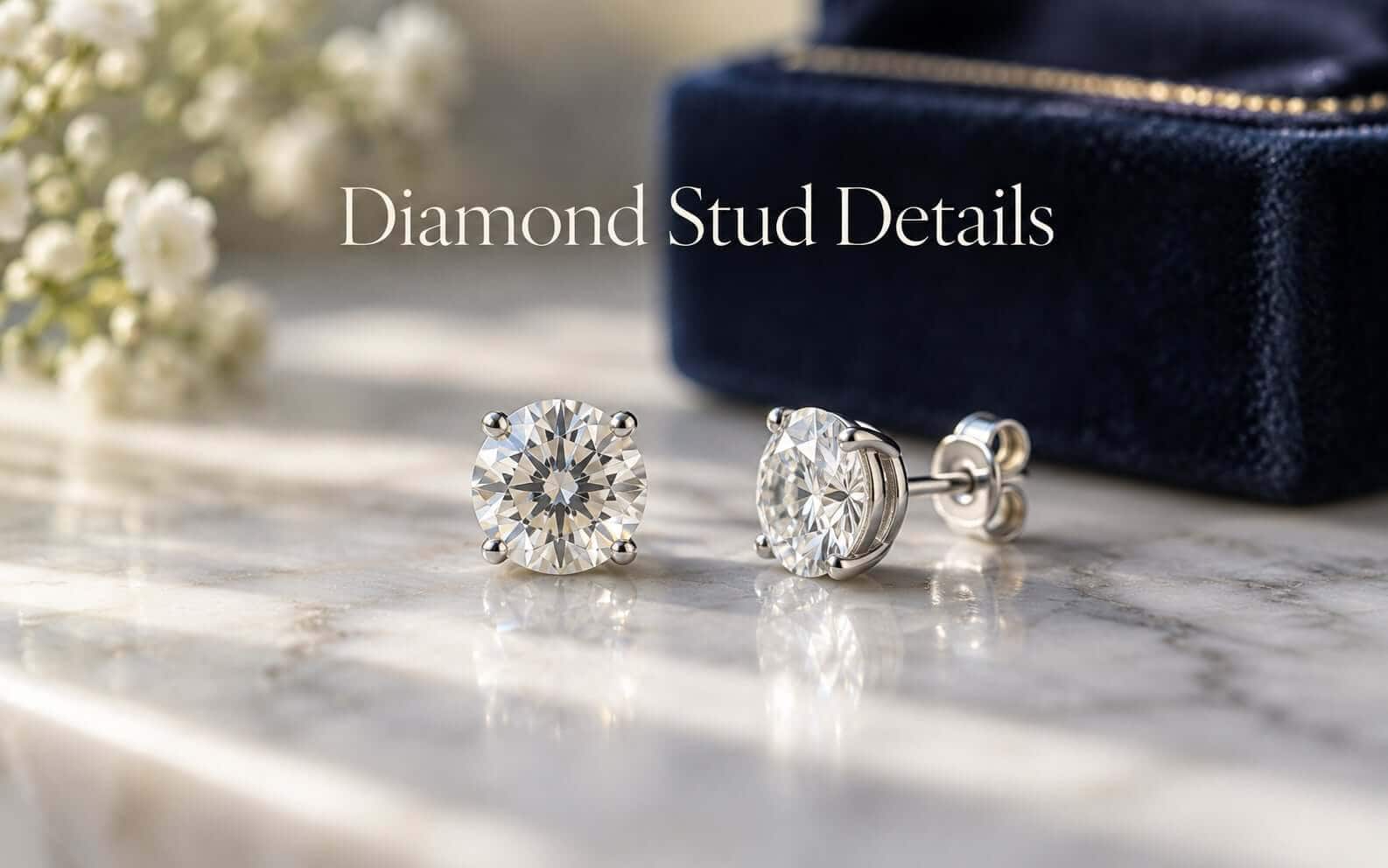

There is a particular pleasure in a pair of diamond studs that looks right the moment it is put on. The earrings sit as they should, the two sides feel balanced, and the light is noticeable without the setting demanding attention. You see the person first, then the diamonds.
That effect is easy to admire and harder to reduce to a product label. Larger stones can create more presence. Higher colour and clarity grades can have their own appeal. But the quality of diamond stud earrings is not simply the highest number or most impressive adjective in a description. It is the way two diamonds, two settings and their fastenings work together.
For a pair you expect to keep reaching for, start with that complete picture. The aim is not to find two admirable stones in isolation. It is to choose one convincing piece of jewellery, worn in two places.
At A Glance
Judge the pair together. Compare their appearance, understand how the total weight is distributed, inspect the settings from the side and confirm the supplied backs. A colour or clarity label is not a complete specification.
Table Of Contents
- Judge The Pair Before The Individual Diamonds
- Let Cut Support The Look You Want
- Read Carat Weight As A Total, Not A Picture
- Notice The Setting From The Side
- Give The Backs As Much Attention As The Fronts
- Decide What Better Colour And Clarity Mean To You
- Make The Final Comparison In The Right Order
- A Better Pair Is One You Want To Wear
- Find The Pair You Will Keep Reaching For
- Frequently Asked Questions
Judge The Pair Before The Individual Diamonds
Two earrings can share a broad description without giving precisely the same visual impression. A useful comparison therefore begins with both together, under the same lighting and at the same distance. Look for an even sense of scale, a compatible colour appearance and a similar character of sparkle.
You are not looking for laboratory-identical objects. Natural diamonds have individual characteristics. You are looking for a deliberate pairing in which neither side feels noticeably out of place. GIA's guidance on choosing diamond studs explicitly notes that the diamonds' quality characteristics need to be matched. Treat that as a reason to ask about the selection of the pair, not simply the grade of each stone.
Ask to see the actual earrings together where possible. Separate, magnified product images are useful for detail, but do not make a reliable side-by-side comparison. A photograph of a representative design also cannot establish the exact appearance of the stones selected for a particular order.
The useful question is, "How are the two diamonds matched?" A clear answer might discuss their measurements, colour, clarity and overall appearance. It gives you more to work with than a promise that both are beautiful.
Let Cut Support The Look You Want
The shape of a diamond is its outline. Cut quality concerns how its facets and proportions work with light. The GIA explanation of diamond cut makes that distinction and describes its grading system for standard round brilliant diamonds in the D-to-Z colour range.
That matters because a round stone is not automatically a well-cut round brilliant, and a high colour grade is not a substitute for lively light performance. Where an individual report is supplied, look at the relevant cut information as well as colour and clarity. Where one is not supplied, ask what information is available rather than inventing a grade from a photograph.
In practice, compare the earrings beyond a single burst of sparkle under a spotlight. Request views in softer, ordinary light as well. You are choosing how the pair will look over a working day or an evening, not awarding a prize for the brightest instant in a promotional video.
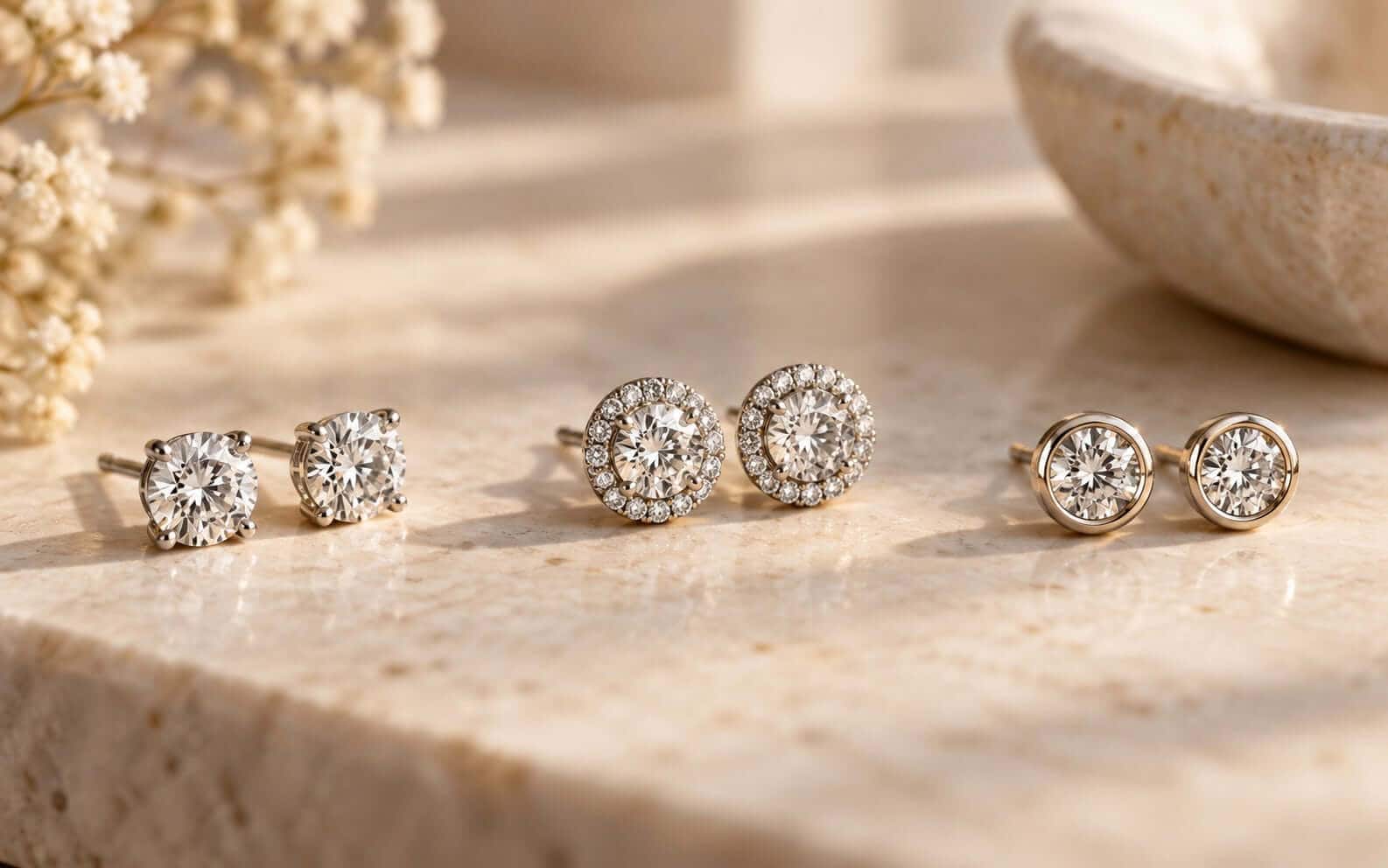
A straightforward claw-set design is a useful place to start that comparison because it gives a relatively uncomplicated view of the diamonds. The white-gold studs below illustrate that design choice. Their stated G/SI description does not, by itself, establish an individual cut grade or an independent grading report.

The Uncomplicated Solitaire
Diamond Stud Earrings 0.50ct G/SI Quality in 18k White Gold
A round, claw-set pair in 18k white gold, with 0.50ct total diamond weight and a stated G/SI specification. Use the simple outline to compare the pair, then confirm the cut information and fastenings separately.
Compare The Whole Pair
Explore stud designs with the setting, outline and total weight in mind, then ask for the details that photographs cannot settle.
Read Carat Weight As A Total, Not A Picture
At All Diamond, the stated diamond weight for a pair of earrings is the total across both earrings. Its product information explains this convention. A pair described as 0.50ct is therefore not two 0.50ct diamonds.
In a simple two-diamond pair divided equally, that total would mean approximately 0.25ct in each earring. In a halo or cluster, the same total is distributed among more stones. Ask for the centre-stone weights separately when that distinction matters to your choice.
Carat is a measure of weight, not a complete description of the visible design. Request the diameter or width of the centre stones, the overall earring dimensions and, where useful, the depth of the settings. Do not assume that a stated earring width is the diameter of the diamond inside it.
This is not a reason to avoid a halo. It is a reason to appreciate one honestly. A central stone with a surrounding arrangement of smaller diamonds gives a different effect from one uninterrupted solitaire. Choose the structure you enjoy rather than treating one as a disguised version of the other.
The rub-over halo pair below carries the same 0.50ct total diamond weight as the previous example, but uses a different arrangement. It demonstrates why an equal total does not make two designs equivalent. No separate centre-stone weight is stated here, so none has been inferred.

The Same Total, A Different Arrangement
Rub Over Diamond Halo Earrings 0.50ct G/SI Quality in 18k White Gold
A centre-and-halo arrangement in 18k white gold shares 0.50ct of diamonds across the pair. That total includes the surrounding stones; no separate centre-stone weight is inferred from it.
Notice The Setting From The Side
A front-on photograph makes studs appear almost entirely about their diamonds. Turn to the side and the setting becomes easier to judge. Look at the height of the mount, the relationship between the post and the decorative front, and the amount of structure sitting behind the stone.
A design that looks attractively compact from the front may project further than you expected. Another may have a more defined metal border but a profile you prefer. Ask for a side view rather than deciding that a particular setting name guarantees the right fit.
Claw and rub-over settings offer different visual treatments. Claws leave an interrupted edge around the stone; a rub-over setting gives it a continuous metal outline. The choice is partly practical and partly aesthetic. A clean yellow-gold rim can be a deliberate part of the look, not metal that must be made invisible.
The yellow-gold rub-over studs below illustrate that more clearly defined outline. They are a useful alternative for someone who prefers the diamond to be framed rather than apparently suspended. This is a design comparison, not a claim that every rub-over setting is more comfortable than every claw setting.

A Defined Gold Outline
Diamond Rub Over Stud Earrings 0.50ct G/SI Quality in 18k Yellow Gold
An 18k yellow-gold rub-over rim makes the setting part of the design. The pair contains 0.50ct of diamonds in total. Its profile and supplied backs should be checked for the particular order.
Look for an overall design you would be happy to see in profile as well as face-on. Fine jewellery should not have only one flattering angle. For earrings in particular, side views also help you ask more precise questions about how the pair is likely to sit.
Give The Backs As Much Attention As The Fronts
A fastening is not a minor finishing detail. It is part of the experience of putting the earrings on, wearing them and taking them off. An elegant pair that feels fiddly or uncertain may be left in its box more often than you intended.
GIA's stud-earring guide discusses friction, screw and locking backs, and notes that the back must adequately support the size of the earring. It also points out that some people find threaded posts uncomfortable. Those are good reasons to consider security, support and ease of handling together rather than choosing by a fastening name alone.
Ask which backs are actually supplied. Check whether they are straightforward for you to operate, whether replacement backs are available and what to do if the fit becomes loose. Do not infer the fastening from a generic front photograph or from a different size in the same collection.
When you are able to try the earrings, give them more than a moment in the mirror. Turn your head, look from the side and notice how the pair sits without adjusting it repeatedly. The object is not to perform a technical test, but to learn whether wearing them feels natural.
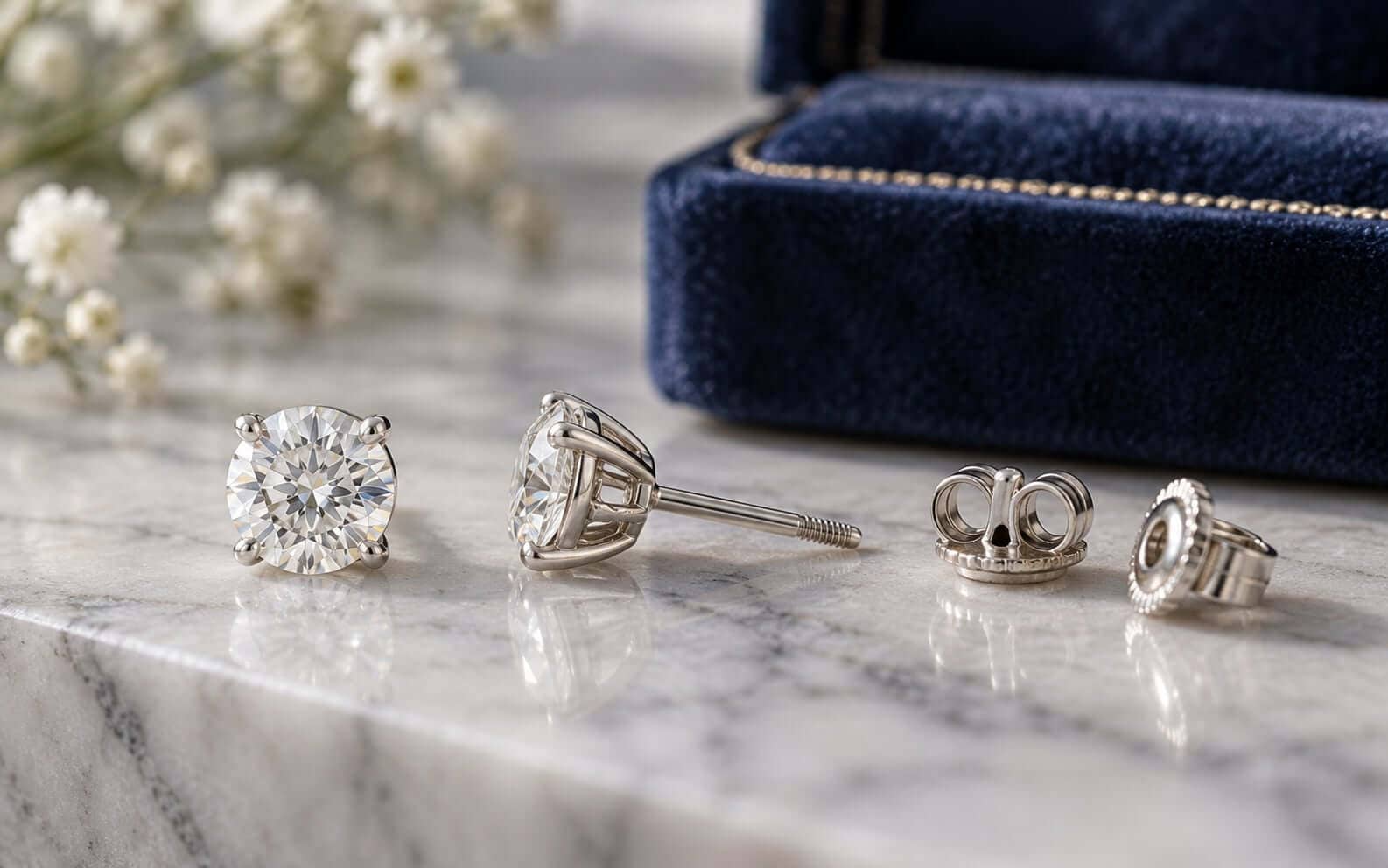
Look at the profile as well as the front, and confirm which backs come with the pair. This image is illustrative, not a product specification.
The product examples here demonstrate visible design choices. They are not a promise about the fastening supplied with every order. Confirm that detail for the particular pair before purchasing, especially when you have a clear preference.
Decide What Better Colour And Clarity Mean To You
Higher grades can be desirable, but first decide what you want the improvement to achieve. Are you seeking a visibly different appearance, closer matching between the earrings, or the satisfaction of owning stones with rarer characteristics? Those are different reasons, and each can be legitimate.
GIA's diamond quality guidance explains that clarity concerns inclusions and blemishes, with their nature and visibility varying between stones. A broad clarity label is therefore useful information, but not a guarantee of identical appearance. Ask what can be seen in the particular diamonds rather than assuming every stone within a grade behaves the same way.
Be especially careful with descriptive terms. "Luxury", "premium" and "exceptional" may describe a retailer's positioning or range. They do not replace named grading information. At the same time, a technical description should not be dismissed just because it lacks glamorous wording. Clear, specific answers are themselves reassuring.
An independent laboratory report and a retailer's product specification are different documents. When reports are supplied, establish which diamonds they cover and read the details for each. Do not treat the absence of an individual report for every small accent stone as proof that the stones were not selected for the piece. Equally, do not assume an earring has an individual report because the description uses familiar grading letters.
For the difference between a grade and what you actually see, our explanation of what GIA grades mean for a diamond's sparkle provides further context. The essential habit is to connect each specification to a question about the pair, rather than collecting impressive letters without a purpose.
Make The Final Comparison In The Right Order
Begin with the overall impression. Do the earrings feel balanced as a pair, and is their presence right for the way you intend to wear them? Then look at the diamonds' appearance and the information supporting it. Follow with the settings, profiles and fastenings. Only then decide whether a larger size or higher grade would add something you genuinely value.
For an online shortlist, ask for the same information about each candidate. Comparing a clear specification for one pair with a beautifully photographed but vaguely described alternative is not a level comparison. Ask the second seller to close the gap before interpreting the price difference.
Keep the final questions compact: what is the total weight; how many stones share it; how are the pair matched; what measurements are available; which backs are supplied; and which documents describe the diamonds? Confirm the seller's current purchase and return terms for earrings too. A generic promise elsewhere on a website is not a substitute for the terms applying to your order.
If you are still deciding between studs, hoops and drops, the broader diamond earrings buying guide is a better starting point. This closer inspection becomes useful once you know that studs are the design you want.
A Better Pair Is One You Want To Wear
The finest-looking choice is not necessarily the largest pair you considered or the one with the most ambitious description. It is the pair whose appearance, construction and handling make sense together, and whose qualities are explained clearly enough for you to choose with confidence.
That leaves room for a personal preference. You may enjoy a distinct gold border, an uncomplicated solitaire or the fuller outline of a halo. You may value a higher grade partly for the knowledge of what you own. None of those choices needs an artificial rule to validate it.
What you should not have to do is overlook a mismatch, accept an unanswered question or work around a fastening you dislike. Exceptional everyday jewellery makes the small details feel settled. With diamond studs, that is what allows two little points of light to become so much more than the sum of their specifications.
Find The Pair You Will Keep Reaching For
Consider a simple solitaire, a defined gold rim or a fuller halo outline. Compare the complete earrings, then choose the design and details that make wearing them a pleasure.
Frequently Asked Questions
What Makes A Good Pair Of Diamond Stud Earrings?
Look for compatible appearance between the two earrings, clear diamond information, well-considered settings and fastenings that work for you. No single carat, colour or clarity figure describes the quality of the finished pair.
Does 0.50ct Mean 0.50ct In Each Earring?
Not in the All Diamond examples shown here. The stated diamond weight is the total across both earrings. In an equally divided two-diamond pair, 0.50ct total would mean approximately 0.25ct per earring; in a halo pair the total includes the accent stones too.
Are Halo Studs The Same As Solitaire Studs At The Same Carat Weight?
No. The same total weight can be distributed among two centre stones or a larger number of centre and accent stones. Compare the arrangement and actual dimensions, and ask for centre-stone weights separately where they are not stated.
Are Screw Backs Always The Best Choice?
Not for everyone. Consider support, security, comfort and how easily you can operate the fastening. GIA notes that some people find threaded posts uncomfortable. Confirm the backs supplied with the particular pair rather than inferring them from a front photograph.
Do All Diamonds In Stud Earrings Have Individual Reports?
Do not assume so. A retailer specification and an independent laboratory report are different forms of information. Ask which reports are supplied and which stones they cover; the absence of individual reports for small accents is not proof that they were not selected for the piece.