
Natural diamonds are entering an unusual period. Our earlier look at natural diamonds in 2026 set out the changing luxury context; the question here is what comes next.
They are still one of the world’s most recognisable luxury materials, yet they now sit beside lab-grown diamonds that can reproduce diamond chemistry and appearance at rapidly changing prices. At the same time, the natural-diamond trade is being pushed towards better traceability, clearer origin stories and more disciplined explanations of what makes a mined diamond different.
That does not mean the future is obvious.
Natural-diamond prices have been under pressure in parts of the market, lab-grown diamonds have expanded consumer choice, and the industry has every incentive to present its own prospects optimistically. A useful view therefore starts by separating what we can observe from what anybody merely hopes will happen.
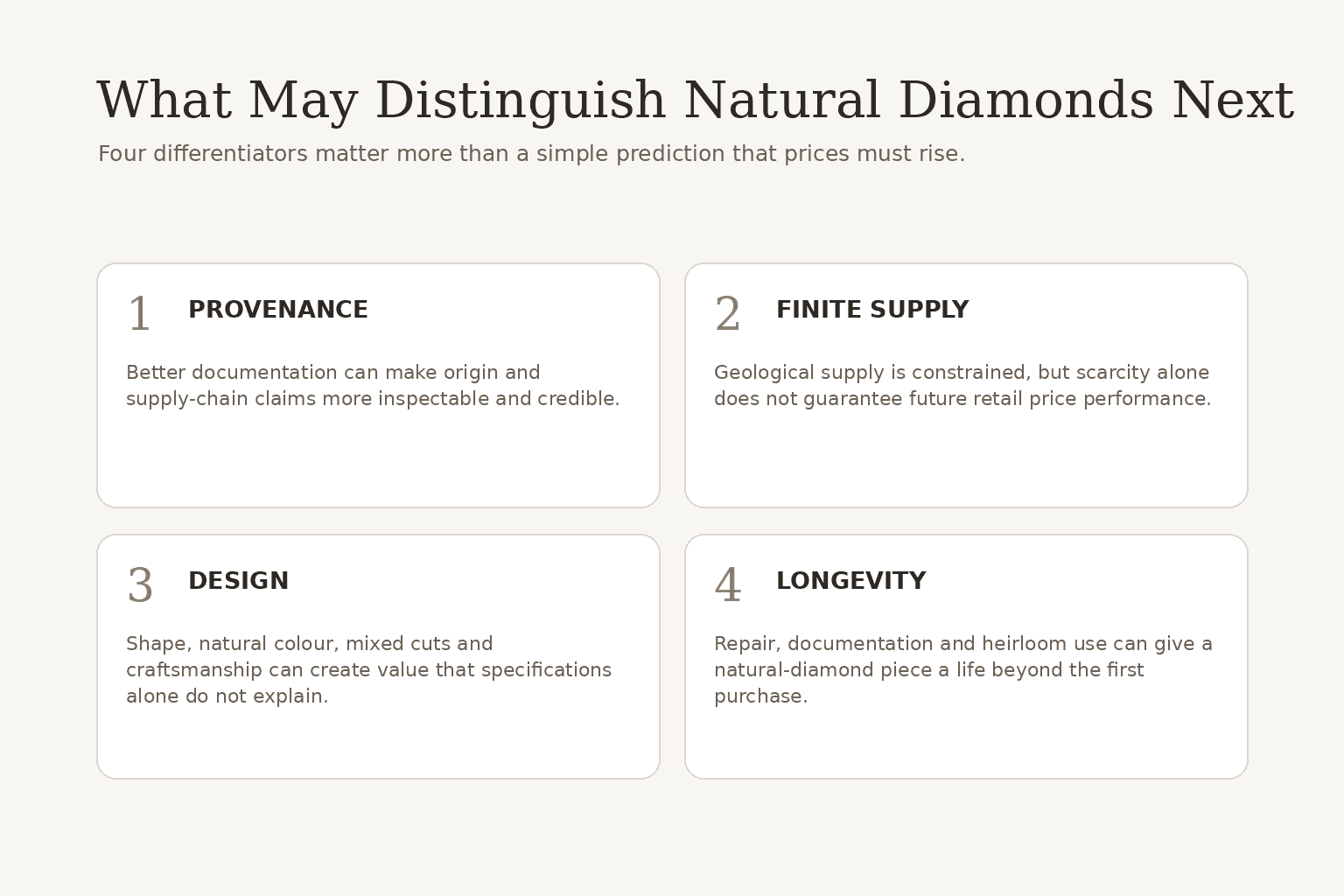
The strongest case for natural diamonds in the years ahead is unlikely to be “diamonds always go up”. It is more specific: finite geological supply, verifiable provenance, distinctive design and emotional longevity can become easier for buyers to see and understand.
Table Of Contents
- Natural Diamonds Will Need To Explain Their Difference Better
- Finite Supply Is Real, But It Is Not A Price Guarantee
- Provenance Is Moving From Reassurance To Infrastructure
- Lab-Grown Diamonds Are Changing The Natural-Diamond Proposition
- Design Will Matter More Than Specification Theatre
- Natural Colour May Become More Important
- Heirloom Logic May Become More Explicit
- What The Natural-Diamond Market May Look Like By 2030
- What Buyers Should Do Now
- The Future Is Likely To Be More Specific
- Explore The Jewellery
- Frequently Asked Questions
Natural Diamonds Will Need To Explain Their Difference Better
For decades, many buyers simply encountered “diamond” as one category. The natural origin of the stone was assumed.
That is no longer enough.
Lab-grown diamonds are diamonds, and modern gemmological laboratories can identify them. Their existence has made origin a purchasing choice rather than invisible background information. As the categories separate more clearly, a natural diamond has to communicate why its geological origin matters to the particular buyer.
For some, the answer will be rarity. For others it will be age, natural formation, provenance, family continuity or the simple preference to own something produced by geological processes rather than manufacturing.
The important point is that natural diamonds can no longer rely on ambiguity. Clear category language is good for both markets.
Finite Supply Is Real, But It Is Not A Price Guarantee
Natural diamonds take geological time to form and can only be mined where economically workable deposits exist. That gives them a supply constraint that manufactured diamonds do not share.
Industry data also points to lower natural rough output than at the previous decade’s peak. De Beers’ June 2026 Diamond Report says about 100 million carats of rough diamonds were produced in 2025, compared with about 150 million in 2017.
That is useful context, but it should not be converted into a promise that retail diamond prices must rise. Prices are shaped by demand, inventory, exchange rates, changing tastes, trade conditions and the mix of diamonds reaching the market. Recent natural-diamond pricing has been uneven rather than uniformly strong.
Scarcity therefore matters most as a category characteristic, not as a simple investment forecast.
Shape Is One Way Natural Diamonds Can Feel More Individual
A future built only around larger round stones would be a narrow one. Fancy shapes give buyers a more personal visual language. The Certified Marquise Diamond Engagement Ring 0.50ct E/VS in Platinum is a useful example: a natural marquise diamond creates an elongated silhouette that feels markedly different from the familiar round brilliant while retaining a classic platinum setting.

Design Example
Certified Marquise Diamond Engagement Ring 0.50ct E/VS in Platinum
The elongated marquise shape shows how natural-diamond jewellery can feel individual without abandoning a classic platinum setting.
Provenance Is Moving From Reassurance To Infrastructure
This may be the most consequential change.
“Responsibly sourced” has often appeared as a general statement. The practical foundations are explored in more detail in our guide to the ethical sourcing of natural diamonds. The next stage is a stronger chain of evidence that can connect a polished natural diamond to verified upstream information.
GIA already offers Diamond Origin Reports for eligible stones where rough-diamond data was captured before polishing. In May 2026, GIA announced an agreement to acquire a 30 per cent shareholding in Tracr, the provenance platform originally backed by De Beers. The significance is not that blockchain suddenly makes every diamond transparent. It does not. The significance is that provenance infrastructure is becoming more institutional and potentially more interoperable across the trade.
For consumers, the practical direction is clear: more diamonds may arrive with richer digital and documentary histories.
That matters because provenance can do something marketing language cannot. It can make a claim inspectable.
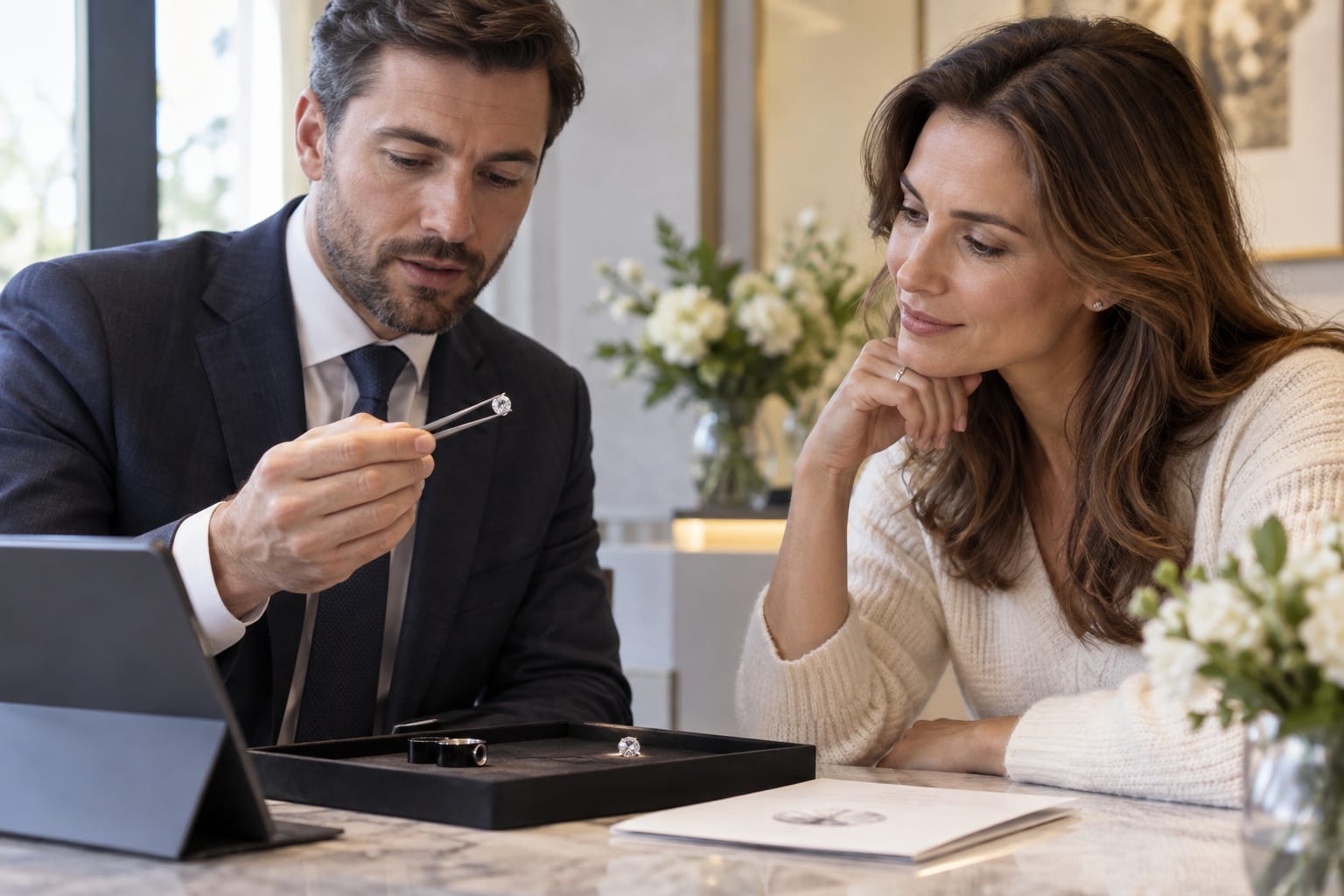
Prefer Your Diamond To Begin With Nature?
Explore natural diamond rings in classic and fancy shapes while keeping the focus on design, proportion and the stone you genuinely prefer.
Lab-Grown Diamonds Are Changing The Natural-Diamond Proposition
The useful comparison is not “real versus fake”. Both natural and lab-grown diamonds are diamond. For the personal case for geological origin, see why I still choose natural diamonds.
The distinction is origin and economics.
Lab-grown supply can expand with manufacturing capacity. Natural-diamond supply is constrained by geology, mining economics and existing inventory. Lab-grown wholesale and retail prices have also fallen substantially over recent years, which has widened the difference between the two categories in some parts of the market.
This changes how natural diamonds are likely to be sold.
If a lab-grown buyer can access size and high grades at much lower prices, natural-diamond jewellery has less reason to compete by shouting about carat alone. The stronger proposition becomes why this particular natural stone, in this particular design, deserves to exist as an object of lasting value to the wearer.
That is a more demanding sales proposition, but probably a healthier one.
Design Will Matter More Than Specification Theatre
The future natural-diamond buyer may still care about the 4Cs, but specifications alone are increasingly poor differentiation.
Design can do more.
Mixed cuts create rhythm. Unusual proportions create identity. Yellow, brown and other natural colours make geological variation visible. Settings can make smaller diamonds feel architecturally deliberate rather than simply less expensive.
This is already familiar in high jewellery, where the stone matters enormously but so does the composition around it. The same logic is moving into more accessible fine jewellery.
A Classic Can Survive Technological Change
Not every future-facing piece has to look futuristic. The Baguette Diamond Tennis Bracelet 3.00ct G/SI in 18k White Gold uses a line of natural baguette diamonds in a channel setting. Its strength is almost the opposite of novelty: the geometry is clean, recognisable and easy to understand. New provenance technology can sit behind a piece like this without changing the reason it is worn.

Related Style
Baguette Diamond Tennis Bracelet 3.00ct G/SI in 18k White Gold
A line of channel-set baguette diamonds shows how enduring geometry can remain relevant even as provenance technology and category language evolve.
Natural Colour May Become More Important
Fancy-colour natural diamonds already occupy a distinct part of the diamond world because colour makes geological variation obvious.
They also demonstrate an important future principle: natural diamonds are not one perfectly standardised product. They vary.
A yellow diamond can be desirable precisely because it departs from the colourless ideal. Antique cuts can appeal because they preserve a different cutting language. Inclusions that would lower one buyer’s preference may fascinate another when they are understood as natural features rather than defects to be hidden.
This does not mean every unusual stone becomes valuable. It means a more mature natural-diamond market can make room for character as well as grade.
Colour, Cut And Period Influence Can Work Together
The Art Deco Cushion Yellow Diamond 0.65ct Rub Over Ring in 18k Yellow Gold brings together a fancy yellow cushion centre with white diamonds in round and baguette shapes. The mixed geometry and colour contrast show how a natural diamond can be valued as part of a composition rather than treated as a commodity measured only by size.

Design Example
Art Deco Cushion Yellow Diamond 0.65ct Rub Over Ring in 18k Yellow Gold
A fancy yellow cushion centre with round and baguette white diamonds demonstrates how natural colour and mixed cuts can give a piece identity beyond carat weight alone.
Heirloom Logic May Become More Explicit
Natural diamonds have always been passed down, but the next generation of buyers may document them more deliberately.
A future heirloom could carry the usual invoice and grading report alongside digital provenance information, photographs, service records and a written family history. That is a small operational change with a large emotional effect.
It also shifts attention from resale to continuity.
Most consumers should not buy ordinary retail diamond jewellery on the assumption of guaranteed financial appreciation. But a piece can still have durable value because it can be repaired, worn for decades, remodelled and transferred between generations.
That is a different definition of “holding value”, and for jewellery it is often the more honest one.
What The Natural-Diamond Market May Look Like By 2030
No one can know the exact answer, but several directions are plausible enough to plan around.
First, natural and lab-grown diamonds will probably be described more explicitly as separate categories. Ambiguous selling becomes harder as testing and disclosure improve.
Second, provenance will become more visible. Not every stone will have a complete origin trail, but the expectation of documentation is moving upward.
Third, design will carry more of the value proposition. If specifications can be compared instantly, creativity, craftsmanship and proportion become more important, not less.
Fourth, natural scarcity will be discussed with greater discipline. The existence of finite supply is factual. Future price performance is not.
Fifth, the emotional proposition will become more personal. Engagement will remain important, but self-purchase, anniversaries, achievements and collection-building give natural diamonds more reasons to be bought outside the traditional proposal script.
The result may be a smaller, clearer and more differentiated natural-diamond proposition rather than a return to the old market.
What Buyers Should Do Now
You do not need a forecast to make a good natural-diamond purchase.
Start with the stone and design you actually prefer. Verify that the diamond is natural if that matters to you. Understand the grading information rather than simply chasing the highest numbers. Ask what documentation comes with the piece and keep it. Look at the setting with the same seriousness as the stone. Think about whether you will still want to wear the design when the current trend cycle has moved on.
Most importantly, do not buy because somebody promises that scarcity will make you rich.
Buy because the combination of natural origin, beauty, craftsmanship and meaning is worth paying for to you.
The Future Is Likely To Be More Specific
Natural diamonds do not need to win every jewellery purchase to remain important.
They need to become easier to understand.
A buyer should be able to know that the stone is natural, see what is known about its origin, understand its quality, appreciate the design and decide whether those things justify the price. That is a much stronger foundation than mystique alone.
The natural diamond of the future may therefore come with more information than the diamond of the past.
If the industry gets that right, the extra information will not make the stone feel less romantic. It will make the romance more credible.
Choose A Natural Diamond For The Reasons That Matter To You
Browse natural diamond jewellery with clearer priorities: origin, beauty, craftsmanship and a design you will still want to wear long after today’s debate moves on.
View Natural Diamond Jewellery
Frequently Asked Questions
Will natural diamonds become rarer in the future?
Natural diamonds are geologically finite and new mine supply depends on viable deposits, but market availability also includes existing inventory and recycled stones. Lower mine production does not automatically mean every diamond will become difficult to buy.
Will lab-grown diamonds replace natural diamonds?
They are likely to remain separate choices. Lab-grown diamonds offer a manufactured route to diamond material, while natural diamonds offer geological origin and finite supply. Different buyers can value those characteristics differently.
What is diamond provenance?
Provenance is documented information about where a diamond came from and how it moved through the supply chain. Some services can connect eligible polished natural diamonds to verified rough-diamond origin data.
Are natural diamonds a safe investment?
Normal retail diamond jewellery should not be treated as a guaranteed financial investment. Prices can move in both directions. Buy for the combination of beauty, provenance, craftsmanship and personal value rather than a promise of appreciation.
What will matter most when buying a natural diamond in the future?
Clear disclosure, reliable grading, provenance where available, strong design, a sound setting and good records are likely to matter more as buyers become better able to compare natural and lab-grown options.