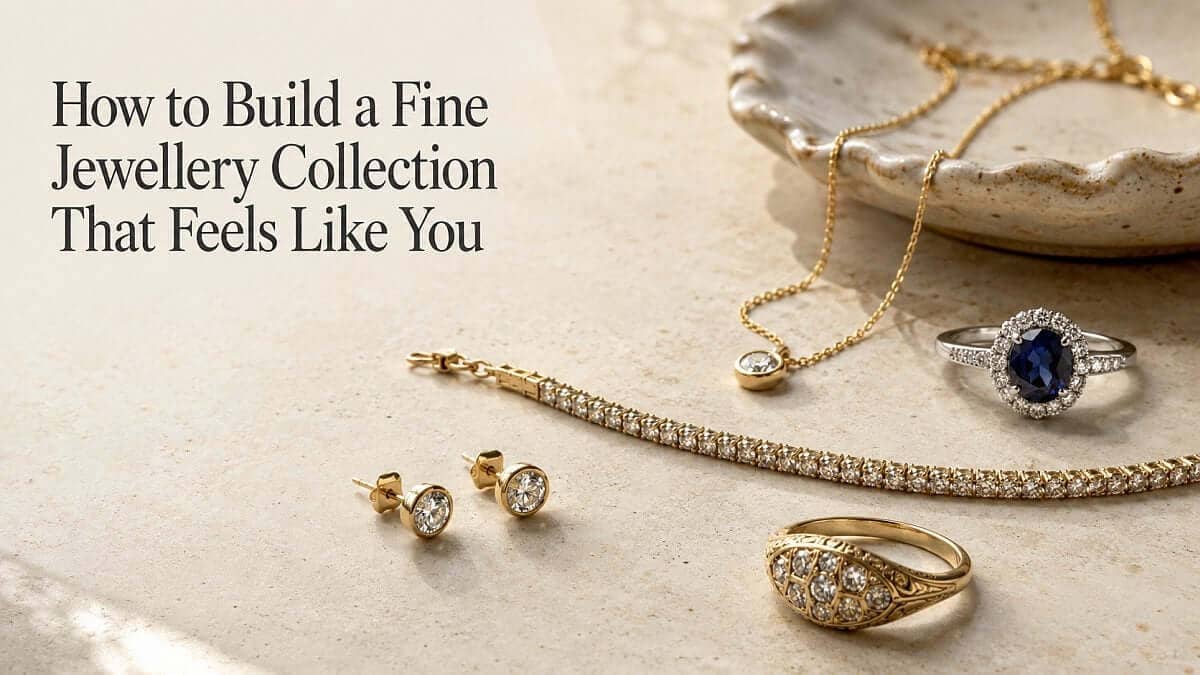

Curation, not accumulation, is what gives a jewellery collection its personality.
Most jewellery boxes are not curated. They are accumulated.
A pair of earrings arrives for a birthday. A ring is chosen during a particular season of life. A pendant once belonged to somebody else. One purchase is carefully researched, while another is made simply because the colour is impossible to resist. The result may look less like a collection than a private archive.
And yet, patterns begin to appear. The same metal returns. Certain gemstone colours feel immediately familiar. The same scale or silhouette keeps winning, even when the wearer cannot quite explain why.
The task is not to replace everything with a matching set. It is to notice the pattern and make future choices with it in mind.
In Brief
Begin with the pieces you already love and the life you actually live. Build around one or two dependable anchors, repeat a few visual ideas, and leave room for colour, sentiment and surprise. Buy slowly enough to notice what you genuinely wear. The goal is not perfect coordination. It is a collection whose pieces feel related because they belong to the same person.
A thoughtful guide to building a fine jewellery collection through real life, recurring details, personal colour and pieces that carry meaning.
Table Of Contents
- A Collection Is Not A Checklist
- Begin With The Jewellery You Already Reach For
- Build Around The Life You Actually Live
- Choose Anchors, Then Add Contrast
- Look For Relationships, Not Matching Sets
- Decide What You Want To Repeat
- Leave Room For One Beautiful Disruption
- Buy Slowly Enough To Learn From What You Own
- Choose Quality That Can Remain Part Of The Story
- Edit Without Erasing Your History
- Keep The Collection Visible, Wearable And Cared For
- Let The Collection Change As You Do
- Find The Next Piece That Belongs
- Fine Jewellery Collection FAQs
A Collection Is Not A Checklist
A practical capsule jewellery collection solves a useful question: which small group of pieces will cover most of my life? A personal collection asks something different: what makes these pieces feel as though they belong to me? The first is about coverage. The second is about identity.
That distinction matters. Two women can own diamond studs, a pendant, a bracelet and a ring, yet the collections can feel entirely different. One may be architectural, cool-toned and sharply edited. The other may be warm, colourful and softened by inherited pieces. The categories do not create the personality. The relationships between the pieces do.
Begin With The Jewellery You Already Reach For
Before buying anything, look at what is already there.
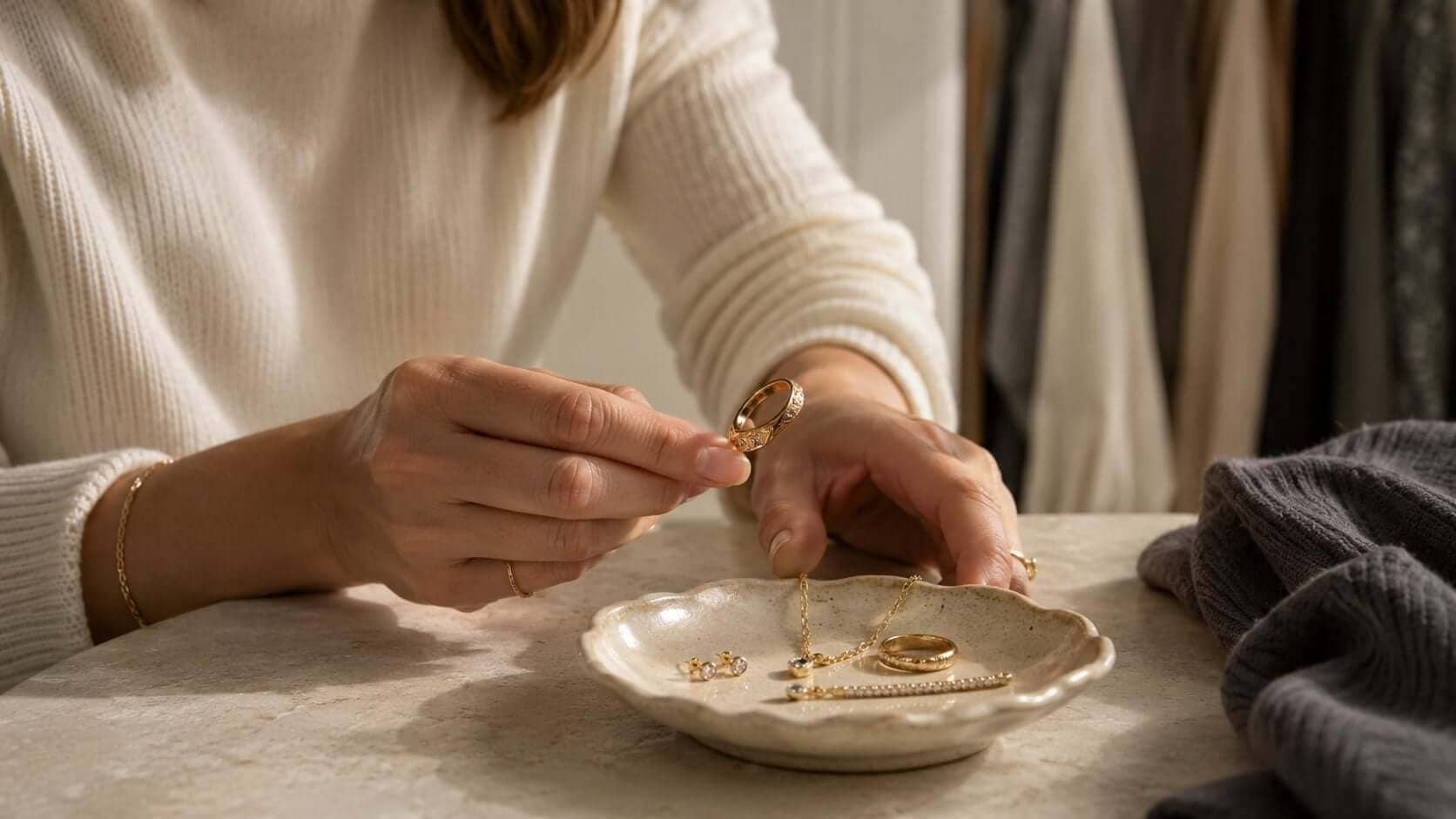
Take the pieces you wear most often out of the box and place them together. Ignore what you think ought to be important. Pay attention to what your hands choose when there is no wedding, dinner or carefully planned outfit to influence the decision.
Those favourites contain more information than a trend report. They reveal the weight you find comfortable, the metal colour that feels natural against your skin, the scale that suits your features and the amount of visual attention you enjoy.
Then look at the pieces you admire but rarely wear. The reason may be practical: a high setting catches on clothes, a clasp is awkward, a chain sits at the wrong length or a ring no longer fits. The reason may be aesthetic: the piece belongs to an imagined version of your style rather than your actual one.
Neither group should be judged. The frequently worn pieces show what works. The unworn pieces show where aspiration and reality have drifted apart. Both are useful when deciding what the collection needs next.
A Useful First Edit
- Which pieces do you wear even when nobody else will notice?
- Which metal, gemstone colour or shape appears repeatedly?
- What do your favourite pieces have in common physically: weight, profile, length or fastening?
- Which unworn pieces need repair, alteration or a different styling context rather than replacement?
Build Around The Life You Actually Live
Fine jewellery is often photographed as though its natural habitat were a marble table and a perfectly lit evening. Most of its life is far less theatrical.
It is worn while answering messages, carrying shopping, travelling, working, meeting friends and pulling a coat over a sleeve. A collection becomes useful when it understands those ordinary movements.
Someone who works with her hands may prefer smooth settings, secure earrings and pieces that do not need constant adjustment. Someone who dresses simply may enjoy using jewellery as the strongest point of the outfit. A person with a full calendar of dinners and events may genuinely need more evening pieces than somebody whose favourite clothes are knits, shirts and denim.
There is no moral superiority in owning only everyday jewellery. A dramatic ring that appears six times a year can still deserve its place. The mistake is forcing every piece to pretend it serves the same purpose.
Give each item an honest role. Some pieces are daily anchors. Some provide polish when an outfit needs structure. Some carry colour. Some are there for celebration. A collection feels more coherent when the pieces are chosen for the life they will actually enter.
The Daily Anchor

Diamond Stud Earrings 0.50ct Premium Quality in 18k Yellow Gold
A pair of natural diamond studs earns its place by asking very little of the rest of the outfit. The scale is quiet enough for ordinary days, while the yellow-gold setting gives the collection a warm and recognisable home base.
Looking for an everyday anchor? Explore All Diamond's natural diamond and gemstone jewellery with your real wardrobe and routines in mind.
Choose Anchors, Then Add Contrast
Most personal collections benefit from one or two anchors. These are the pieces that make getting dressed easier and give the rest of the jewellery something stable to sit beside.
An anchor might be diamond studs, a simple pendant, a slim band or a bracelet that can be worn without ceremony. It does not need to be plain, and it certainly does not need to be invisible. It simply needs to be dependable.
This is where restrained design can become surprisingly expressive. When a piece relies on proportion, setting and finish rather than scale alone, every detail begins to matter. A clean rub-over setting, a well-judged chain length or the exact warmth of yellow gold can establish the tone of the collection more effectively than a larger but less considered piece.
Anchors also make contrast easier. Once a quiet visual rhythm exists, a coloured gemstone, sculptural ring or stronger pair of earrings can enter without making the whole collection feel disconnected.
Think of the anchor as the room in which the more dramatic pieces are allowed to speak.
The Quiet Link

Classic Rub Over Diamond Solitaire Pendant 0.40ct G/SI 18k Yellow Gold
A simple rub-over pendant can connect work, weekend and evening wardrobes without competing with other jewellery. Its value to a collection lies in continuity: it can sit beside stronger rings, coloured gemstones and changing necklines while remaining unmistakably itself.
Look For Relationships, Not Matching Sets
Exact matching is only one form of coherence, and often the least interesting one.
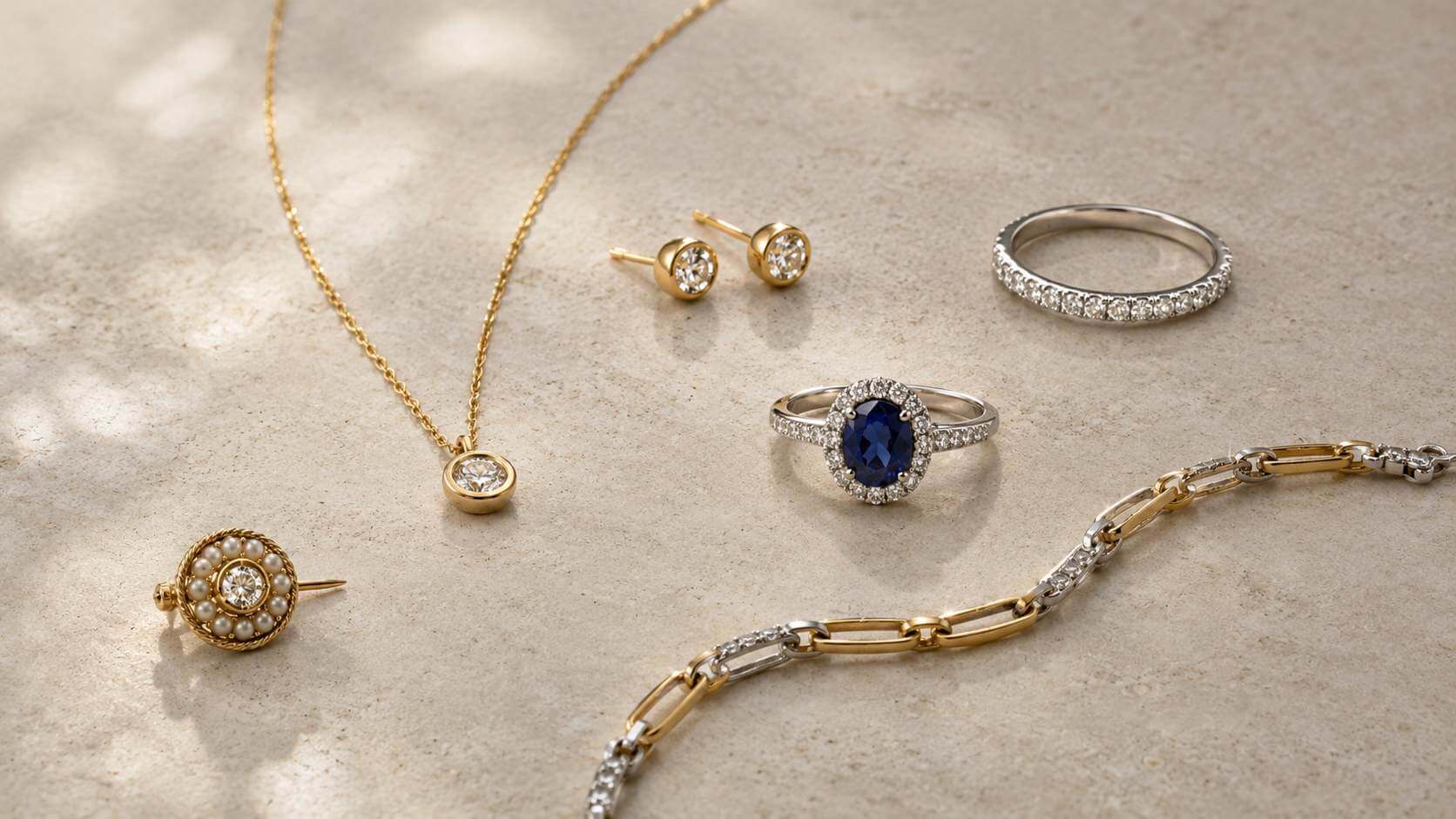
A collection can feel connected because several pieces share a metal colour. It can also feel connected through repeated geometry, similar visual weight, a recurring gemstone or the same balance of polished metal and light. A vintage-inspired ring and a modern pendant may sit beautifully together if both have strong symmetry. Yellow gold earrings can work beside a white-gold sapphire ring if their scale and clarity of design create a convincing conversation.
The point is not to invent a complicated set of rules. It is to notice why two pieces look comfortable together.
Four relationships are especially useful when you are deciding whether a new piece belongs:
Colour: A repeated metal or gemstone tone creates continuity, even when the designs differ.
Shape: Ovals, circles, clean lines or softened geometry can echo one another across categories.
Scale: Pieces with a similar visual weight often sit together more naturally than pieces chosen only because their materials match.
Mood: Quiet modern pieces, romantic gemstone designs and architectural forms each create their own atmosphere.
When mixing metals, repetition helps. One isolated white-metal piece in an otherwise yellow-gold collection may look accidental. A second point of white metal, perhaps a watch, ring or small diamond setting, can turn the contrast into part of the language.
The pieces do not need to clone one another. They need to seem capable of sharing the same life.
Decide What You Want To Repeat
Personal style often becomes visible through repetition long before it becomes conscious.
Perhaps you always return to blue sapphires. Perhaps yellow gold makes everything feel warmer and more complete. You may be drawn to oval stones, bezel settings, Art Deco geometry, delicate chains or diamonds used as points of light rather than a single dominant centre.
Any of those can become a signature, but it should remain a tendency rather than a uniform. A signature is not a logo stamped across every purchase. It is a recurring choice that makes the collection recognisable without making it predictable.
Colour is particularly powerful because it can carry both atmosphere and memory. A gemstone may matter because of a birth month, an association or a traditional meaning, but it may simply be the colour that has followed you through clothes, interiors and jewellery for years. That private familiarity is often more persuasive than any fixed symbolism.
Once you recognise the thread, future buying becomes easier. You can ask whether a new piece deepens the collection or merely repeats something already present without adding anything.
The Personal Note

Blue Sapphire & Diamond 0.55ct Dress Cocktail Ring in 18k White Gold
This is not a piece that needs to blend into every outfit. Blue sapphire and natural diamonds give it a distinct visual identity, while the white-gold setting proves that a signature piece can depart from the collection's dominant metal and still feel intentional.
Leave Room For One Beautiful Disruption
A collection that follows its own rules too perfectly can become tasteful and strangely impersonal.
Leave room for a piece that disrupts the system. It may be an inherited brooch in a metal you rarely wear, a cocktail ring brighter than anything else you own, a pendant bought while travelling or a gift that would never have appeared on your own shortlist.
Its value may lie precisely in the fact that it does not behave like the rest.
Distinctive jewellery can change the temperature of a familiar wardrobe. A strong ring may make a plain black dress feel deliberate. An old locket can soften a modern shirt. A gemstone colour that appears nowhere else can become more memorable because it is rare within the collection.
The test is not whether the piece matches. The test is whether you want to make space for it.
That is especially true of jewellery connected to another person or an important moment. Emotional coherence is still coherence. A collection belongs to a life, not to a brand identity document.
Buy Slowly Enough To Learn From What You Own
A fine jewellery collection is better built through observation than momentum.
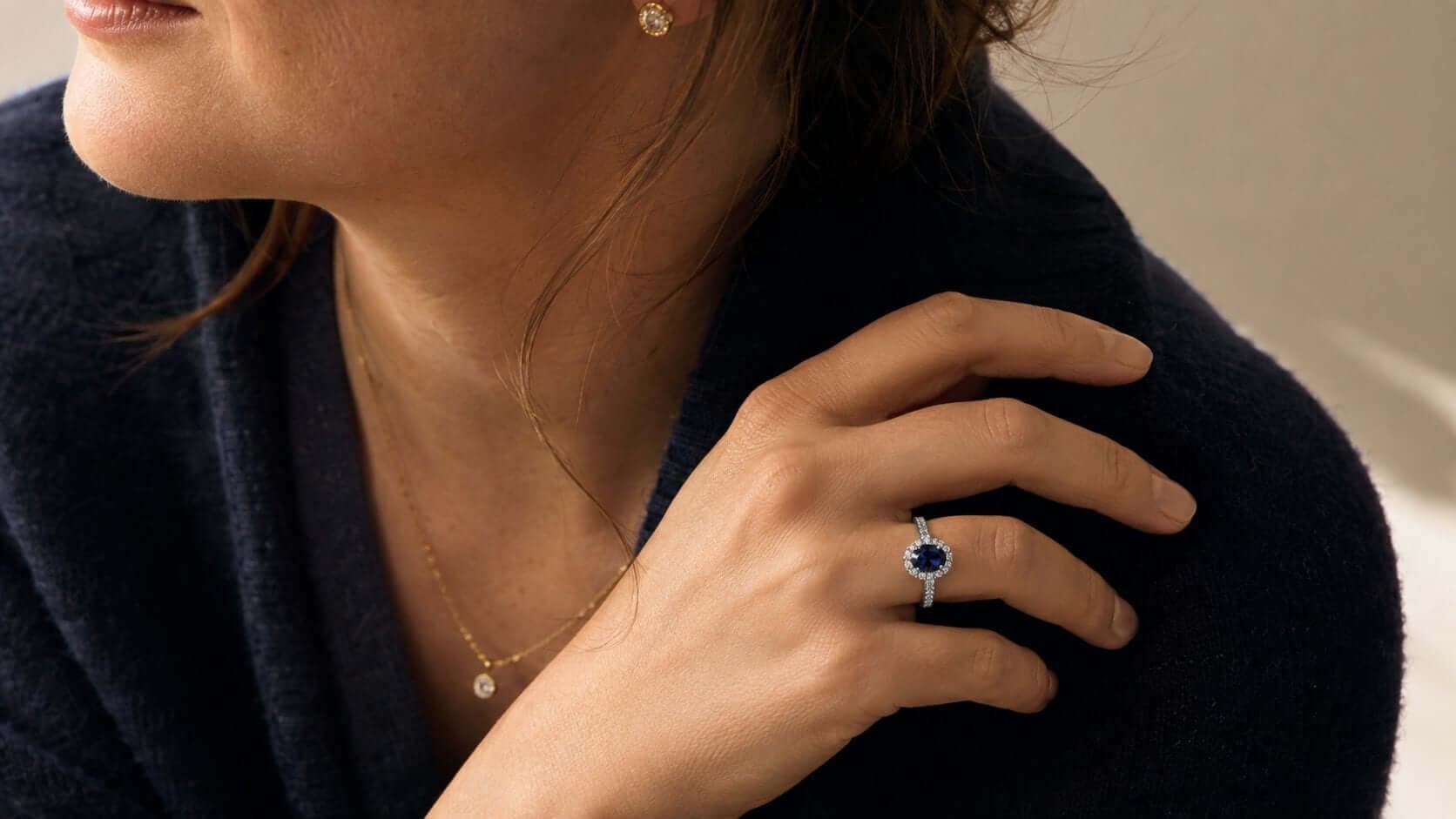
Each new piece creates information. You discover whether a chain length works with your clothes, whether a ring is comfortable through a full day, whether you genuinely mix metals or only admire the idea, and whether a gemstone colour is versatile in your wardrobe or simply beautiful in isolation.
Give yourself time to learn those things before filling the next gap.
A wishlist can help, but describe the role rather than merely the category. Instead of writing 'bracelet', you might write 'a piece that adds light to rolled sleeves but is comfortable at a keyboard'. Instead of 'statement earrings', you might write 'something that gives a dark evening outfit height and movement'. The second description is much more likely to produce a useful purchase.
Slow buying also reveals duplication. There is nothing wrong with owning variations on a favourite idea, but they should be deliberate. Three nearly identical pendants can be a personal signature. They can also be evidence that the collection is circling the same decision without quite making it.
The pause between purchases is not empty time. It is where taste becomes clearer.
Choose Quality That Can Remain Part Of The Story
Not every item in a jewellery box needs to become an heirloom. The pieces at the centre of a fine jewellery collection should, however, be made and documented well enough to remain understandable and wearable over time.
For UK buyers, a hallmark provides independent assurance about the precious metal's fineness and provenance. It does not grade a diamond, judge the design or guarantee the craftsmanship of the complete piece, but it answers an important part of the question: is the metal what it is being described as?
Look beyond the front view. Notice how the stones are held, how a clasp operates, whether an earring back feels secure and whether the chain or band suits the weight of the design. Fine jewellery lives at its joins and moving parts as much as it lives in the centre stone.
Keep invoices, valuations and any grading or treatment information supplied with significant pieces. Photograph them while they are new. If they are altered or repaired later, keep a simple record. These details feel administrative until somebody needs to understand the piece years from now.
The best future heirlooms are not necessarily the most formal or expensive-looking pieces. They are the ones chosen with enough affection to be worn and enough care to survive the wearing.
Edit Without Erasing Your History
Curation sometimes means removing things, but it should not become a purge performed in the name of visual perfection.
An unworn piece may need a new chain, a different ring size, a repaired clasp or a professional clean. It may work better layered, stacked or placed beside something more modern. A stone can sometimes be reset, although irreversible changes deserve thought and specialist advice, especially when the original piece carries age, provenance or family meaning.
It is also reasonable to keep jewellery that is rarely worn. A collection can have an active wardrobe and an archive. The active pieces earn their place through use. The archive earns its place through memory, history or the possibility of a future return.
This distinction removes unnecessary guilt. Not every meaningful object must justify itself through weekly wear.
When a piece has neither use nor emotional hold, passing it on may give it a better life. But edit slowly. Jewellery is unusually capable of becoming relevant again when clothes, routines and tastes change.
Keep The Collection Visible, Wearable And Cared For
A beautiful collection can disappear inside its own storage.
Keep frequently worn pieces accessible, while still protecting them from scratches, tangles and knocks. Fasten chains before storing them. Separate harder gemstones and metal surfaces where they might rub. Give earrings a consistent place so that a missing back does not turn into a missing pair.
Cleaning should suit the gemstone, treatment, setting and metal rather than follow one universal recipe. Gentle methods are often safest, and specialist guidance matters for more delicate or treated stones. GIA's jewellery-care guidance is a useful reminder that what works for one gem may be wrong for another.
Settings and clasps should also be checked after a knock, when a stone seems loose or whenever a fastening begins to feel different. Valuable pieces may need an up-to-date insurance valuation and clear photographs, particularly if the collection has grown gradually and older paperwork no longer reflects replacement costs.
Care is not separate from curation. A piece that is clean, secure and easy to find is much more likely to return to the body, which is where jewellery gains its meaning.
Let The Collection Change As You Do
The aim is not to create a finished collection and defend it against change.
Lives shift. Work becomes more formal or less so. Hands and necklines change. A metal once ignored begins to look right. A gemstone associated with somebody else acquires personal meaning. The jewellery that suited one decade may become an archive, while a new piece quietly takes over as the daily signature.
Coherence should be generous enough to accommodate that movement.
A personal collection is not successful because every item matches. It is successful because the pieces reveal a consistent chooser, even when that chooser has changed her mind. Some objects speak of who she is now. Others preserve who she was, who she loved and what she once found beautiful.
The collection does not need to look complete. It needs to feel alive.
Find The Next Piece That Belongs
The right next piece does not have to fill a category. It should deepen something already present: daily ease, colour, form, light or meaning.
Explore All Diamond's natural diamond and gemstone jewellery collections with an eye on the pieces you will genuinely live with and the visual language you want the collection to develop.
Fine Jewellery Collection FAQs
How many pieces should a fine jewellery collection contain?
There is no correct number. A collection can begin with three or four frequently worn pieces and grow slowly. Coherence, usefulness and personal meaning matter more than reaching a prescribed total.
Should all the jewellery in a collection be the same metal?
No. A dominant metal can create an easy visual foundation, but mixed metals can look intentional when colour, scale, shape or repeated details connect the pieces.
Which fine jewellery pieces are best to buy first?
Begin with the category you already wear most. For many people that means diamond studs, a simple pendant, an everyday ring or a comfortable bracelet, but your real routine is a better guide than a universal essentials list.
How can inherited jewellery fit into a modern collection?
Try a different chain, stacking combination, ring size or styling context before altering the piece. Resetting may be possible, but seek specialist advice before changing jewellery with age, provenance or strong family meaning.
Is it better to buy matching jewellery sets or individual pieces?
Matching sets can be elegant and useful, particularly for formal wear. Individual pieces usually allow a more personal collection to develop because they can relate through colour, shape or mood without being identical.
How often should fine jewellery be cleaned or checked?
It depends on how often the piece is worn, its construction and the gemstones involved. Clean gently using guidance suited to the materials, and have settings or clasps checked whenever something feels loose, damaged or different.