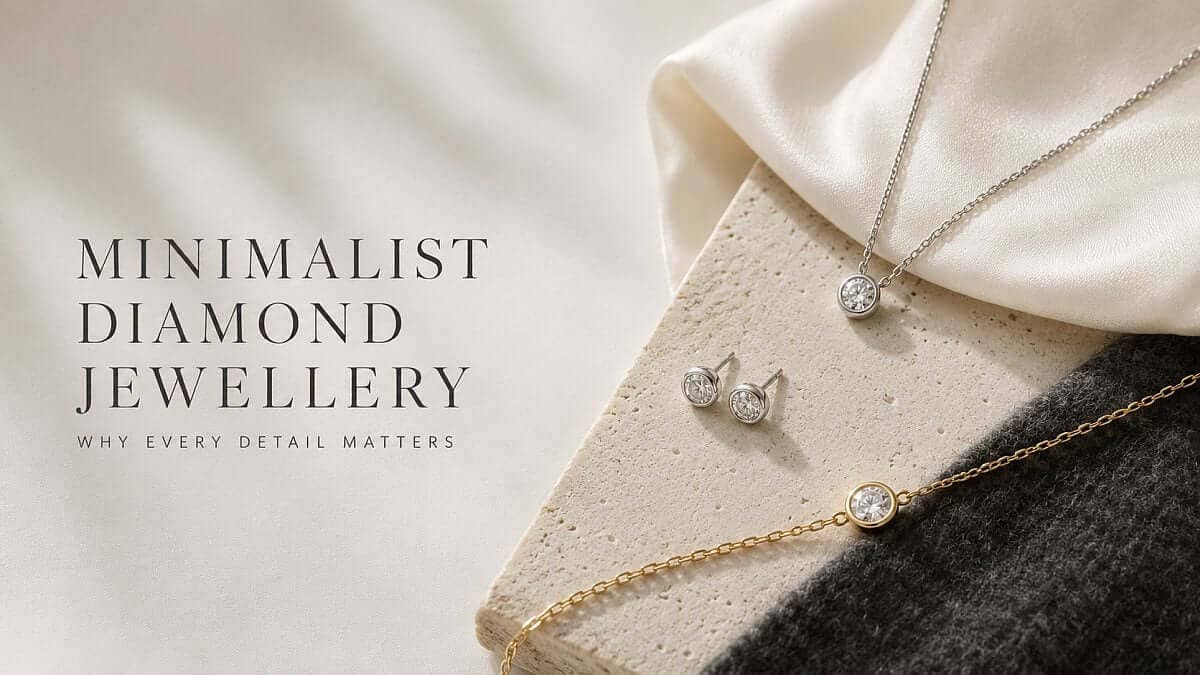

Minimalist jewellery has an image problem.
It looks easy.
One diamond. One fine chain. A clean metal edge. Perhaps a pair of studs with nothing around them at all. Compared with a complicated halo, elaborate cluster or heavily diamond-set piece, what could possibly go wrong?
Quite a lot.
The less a design contains, the more responsibility each remaining element carries. A slightly clumsy setting becomes obvious. A chain that is too heavy overwhelms a small pendant. A chain that is too fine can make it look insubstantial. Poorly balanced claws suddenly have nowhere to disappear. An awkwardly proportioned metal rim becomes part of the entire visual identity of a rub-over setting.
Minimalism removes distraction.
That is precisely why good minimalist diamond jewellery can look so refined, and mediocre minimalist jewellery can look so ordinary.
Table Of Contents
- Minimalism Is Not Simply Using Less
- The Diamond Has To Do More Work
- Proportion Becomes The Decoration
- When The Setting Becomes Part Of The Look
- Simple Metalwork Is Still Metalwork
- A Hallmark Is Important, But It Cannot Judge Beauty
- Minimalism And Everyday Wear Belong Together
- Minimalist Does Not Mean Small
- Nor Does Minimalist Automatically Mean Cheap
- The Test Is Ruthlessly Simple
- When Minimalism Stops Working
- Minimalism Also Makes A Good Partner
- Quiet Jewellery Still Deserves Close Attention
- Choose The Details You Will Keep Seeing
- Frequently Asked Questions
Minimalism Is Not Simply Using Less
The easiest way to misunderstand minimalist jewellery is to define it by absence.
Fewer diamonds. Less metal. Less decoration. Less visual complexity.
That describes quantity, not necessarily design.
A genuinely successful minimalist piece feels resolved. Nothing obvious appears to be missing because the elements that remain have been given enough attention.
Think of a diamond solitaire pendant. At first glance, the design may consist of little more than a stone, a setting and a chain. Yet those three elements create dozens of decisions.
How large should the setting appear relative to the diamond? How much metal should be visible? Where should the pendant sit? How fine can the chain become before it looks fragile? Should the setting almost disappear, or should a polished metal edge deliberately frame the stone?
Take away decorative detail and those questions do not disappear. They become the design.
That is the important distinction. Minimalist jewellery is concentrated design, not absent design.
The Diamond Has To Do More Work
In a diamond cluster, several stones contribute to the overall visual effect. In a halo, surrounding diamonds add brightness, apparent scale and complexity. Pavé can create a continuous field of sparkle.
A solitaire does not have those options.
The centre diamond has to earn the attention itself.
That makes cut especially important. The Gemological Institute of America describes diamond cut in terms of the way a diamond interacts with light, including brightness, fire and scintillation. A well-cut stone can appear lively and balanced, while poorer light performance is harder to disguise when there are no surrounding diamonds creating additional sparkle.
This does not mean minimalist jewellery requires the highest possible grade in every category. Quite the opposite.
A sensible buyer still needs to distinguish between characteristics that materially affect what they can see and specifications that exist mainly on paper. Colour, clarity, carat and cut all matter, but not always equally in every piece.
Our guide to what GIA grades actually mean for your diamond's sparkle goes further into that distinction.
Minimalism simply makes one thing harder to ignore: if the diamond is the design's principal visual event, it needs to look good doing the job.

Design Example
Diamond Solitaire Pendant Necklace 0.25ct G/SI In 18k White Gold
A single round natural diamond in a restrained four-claw setting demonstrates the principle neatly. There is no halo adding apparent size and no decorative framework competing with the stone. The diamond, the balance of the claws and the relationship between the setting and chain create almost the entire design.

Proportion Becomes The Decoration
Minimalist jewellery often replaces ornament with proportion.
That sounds abstract until something is slightly wrong.
Imagine two otherwise identical pendants. One has a heavy chain and a delicate diamond. The second uses a finer chain that allows the stone to remain the visual centre. Neither contains more decoration than the other, but one will usually feel more resolved.
The same principle applies to earrings. A stud can sit close and neatly against the ear, or the setting can dominate the diamond. A bracelet can look like a single point of light carried by a fine chain, or like a small diamond awkwardly attached to two unrelated lengths of metal.
These relationships are difficult to quantify because there is no universal ideal ratio.
They are still visible.
This is where photographs can be surprisingly useful when buying online. Do not inspect only the diamond. Look at the whole object. Look at the side view. Look at how the setting meets the chain or band. Look at the amount of visible metal.
A minimalist piece should still have an obvious hierarchy.
You should know what your eye is supposed to see first.
Explore The Quiet Classics
If your jewellery wardrobe is built around pieces you can wear repeatedly rather than save for a particular outfit, solitaire necklaces are an obvious place to look. The strongest versions do not need to shout. Their job is to look right often.
Explore Solitaire Diamond NecklacesWhen The Setting Becomes Part Of The Look
A setting has two jobs.
It needs to secure the diamond, and it needs to contribute to the design.
In ornate jewellery, that second job can become visually submerged among other details. In minimalist jewellery, it often sits in plain view.
Consider the difference between a claw setting and a rub-over, or bezel, setting.
Claws reveal more of the diamond. The aim is often to let the metal recede visually so that the stone appears more exposed.
A rub-over setting does almost the reverse. A thin rim of metal intentionally surrounds the diamond, turning the boundary between stone and setting into part of the design.
Neither approach is inherently more minimalist.
A badly proportioned claw setting can appear fussy. A beautifully judged rub-over can look exceptionally clean.
There is also a practical trade-off. GIA notes that bezel settings provide substantial protection because metal surrounds the edge of the diamond, although that metal necessarily covers more of the stone than a minimal-prong setting.
The decision is therefore not simply “more metal versus less metal”.
It is which kind of simplicity do you want?

Why This Works
Diamond Rub Over Stud Earrings 0.30ct G/SI Quality In 18k White Gold
Rub-over diamond studs demonstrate how visible metal can strengthen rather than undermine minimalism. Instead of trying to make the setting vanish, the polished white-gold rim becomes part of the clean circular form.

For a broader discussion of how this type of setting changes security and appearance, our guide to rub-over bezel-set jewellery provides useful additional context.
Simple Metalwork Is Still Metalwork
Minimalist jewellery can create the illusion that precious metal is merely supporting infrastructure.
It is not.
Metal defines line, weight, reflection, warmth and the physical relationship between the jewellery and the body.
White gold can visually merge with a colourless diamond and make the setting feel cooler and less conspicuous. Yellow gold produces greater contrast, so even a small amount of visible metal can become a deliberate part of the design. Rose gold can soften the whole composition.
Then there is finish.
A broad polished surface catches light differently from a narrow wire-like edge. A bezel must appear even. Claws should look balanced rather than randomly positioned. The transition from one part of a piece to another should feel deliberate.
These details become more important as decorative complexity decreases.
There may be only one line to look at.
It had better be a good one.
A Hallmark Is Important, But It Cannot Judge Beauty
For UK buyers, hallmarking provides an important reassurance about precious metal.
The purpose of the UK hallmarking system is consumer protection. Qualifying precious-metal articles described as gold, silver, platinum or palladium must carry recognised marks that identify information including metal fineness.
That tells you something important.
It does not tell you everything.
A hallmark cannot tell you whether a pendant is beautifully proportioned. It cannot tell you whether the claws appear balanced, whether the chain suits the setting, or whether the piece sits elegantly when worn.
Metal authenticity and fineness are objective matters. Aesthetic proportion and finishing quality require separate judgement.
For minimalist jewellery, buyers need both forms of reassurance.
The material should be what it claims to be.
The design should also deserve to exist in that material.
Minimalism And Everyday Wear Belong Together
One reason simple diamond jewellery remains useful is that it tends to cooperate with daily life.
A small pendant does not normally dictate an outfit. Stud earrings rarely fight with a neckline. A low-profile bracelet can sit alongside a watch or disappear beneath a cuff.
That adaptability matters.
The best minimalist pieces often become habitual jewellery: the pendant you put on without thinking, the studs that stay useful when everything else changes, the bracelet that works with a shirt in the morning and dinner clothes later.
Our guide to creating a capsule jewellery collection makes a similar argument from the collection level: versatility matters more than simply accumulating categories.
Minimalism can make that easier because the jewellery leaves visual room for other decisions.
It is supporting cast when required and leading character when worn alone.
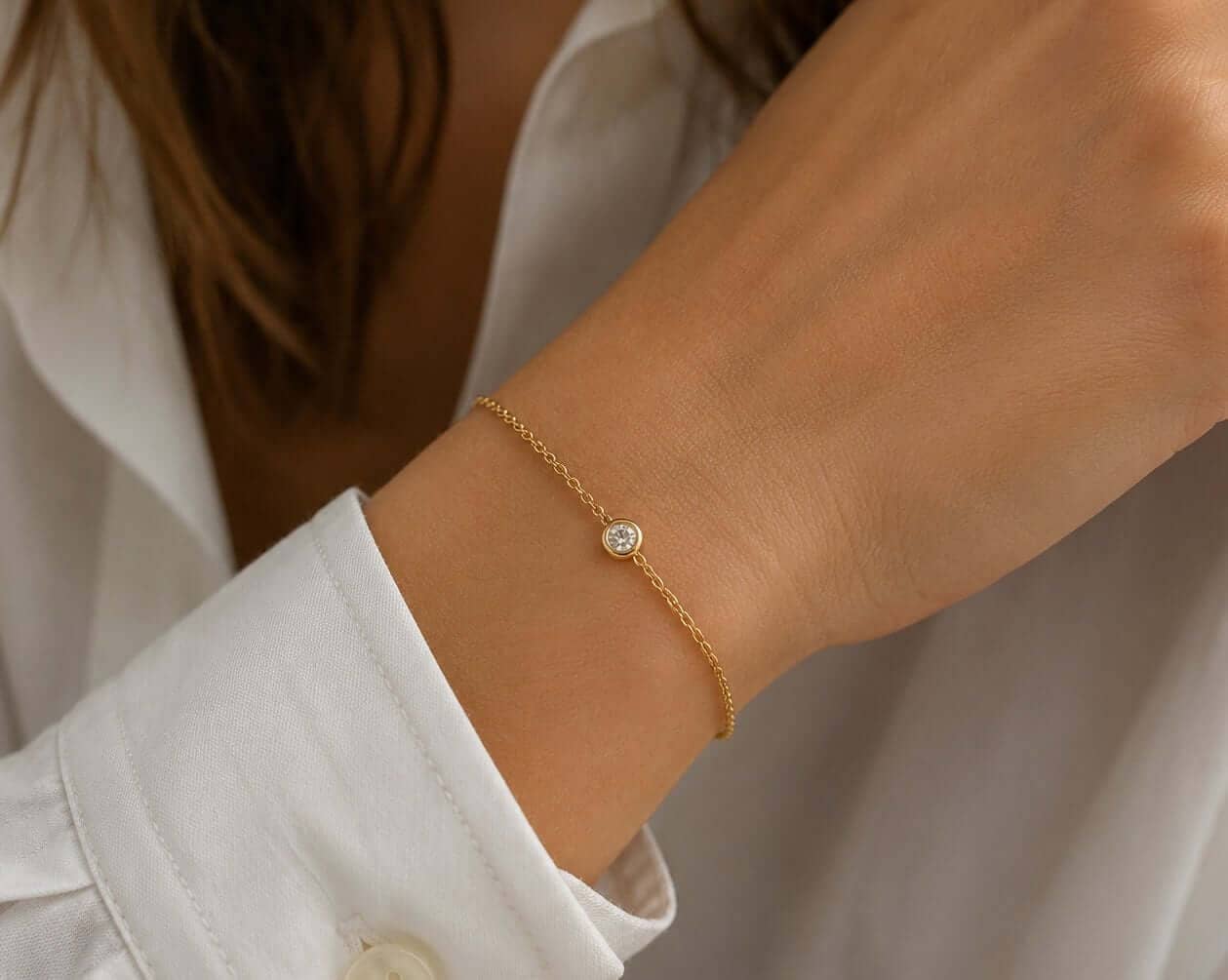
Everyday Minimalism
Solitaire Diamond Bracelet 0.20ct G/SI Quality In 9k Yellow Gold
A solitaire bracelet reduces the composition to one diamond, a fine chain and a deliberate rim of yellow gold. The setting gives the small stone definition while allowing the piece to remain light and easy to wear.

Minimalist Does Not Mean Small
This is another assumption worth discarding.
Minimalism describes the design language, not the carat weight.
A one-carat solitaire can be minimalist. So can a 0.10ct stud.
A large diamond in an extremely clean setting may actually appear more minimalist than several small diamonds arranged into an elaborate pattern.
What changes with size is the balance.
As a diamond becomes larger, the setting may need more physical presence. The chain beneath a pendant may need sufficient visual and structural weight. Larger stud earrings need to sit correctly rather than tipping away from the ear.
“Make everything thinner” is not a design philosophy.
Proportion remains the controlling idea.
Nor Does Minimalist Automatically Mean Cheap
Using fewer stones can reduce material costs. That much is obvious.
But it does not follow that minimalist jewellery should always be positioned as the inexpensive version of something more elaborate.
A simple piece may concentrate value rather than remove it.
Instead of dividing a budget among many diamonds, the buyer may choose one better centre stone. Instead of paying for elaborate decorative setting work, they may prefer a higher gold fineness, platinum, a finer diamond or more exacting construction.
There is no reason the buyer has to do this either. A modest natural diamond in a beautifully judged everyday design can be entirely successful.
The point is that minimalist jewellery gives you fewer components to prioritise.
That can make buying decisions clearer.
It does not make them meaningless.
The Test Is Ruthlessly Simple
One useful way to assess minimalist jewellery is to mentally remove the diamond.
What remains?
Does the metalwork still look intentional?
Then reverse the exercise.
Ignore the surrounding metal and look at the diamond. Does it have enough life to justify being the focal point?
Finally, look at the whole piece at normal viewing distance.
Do the elements work together?
You should not need a loupe to decide whether the design is visually coherent.
For online shopping, I would concentrate on six things:
- Look at the side view. It often tells you more about setting height and construction than the glamour photograph.
- Check the stated dimensions. Carat weight alone does not explain how large an entire earring or pendant will appear.
- Understand the setting. A four-claw solitaire and a rub-over diamond can contain similar stones yet look quite different.
- Check the metal. Colour and fineness affect both appearance and feel.
- Look for hallmarking information. For qualifying UK precious-metal jewellery, this is an important material reassurance.
- Do not ignore the diamond cut. Particularly in a simple solitaire, light performance is part of the visual design, not merely a laboratory specification.
None of that requires becoming a gemologist.
It requires looking at the piece rather than merely counting what it contains.
When Minimalism Stops Working
There is a point where restraint becomes absence.
A chain may be too fine for the pendant it carries.
A setting may strip away so much metal that the design loses definition.
A tiny diamond may be placed into a structure whose proportions make it look accidental.
Minimalism cannot rescue weak decision-making by calling it subtle.
Nor should buyers assume every unadorned piece is timeless simply because it is simple. Proportions date. Setting styles change. Chain weights move in and out of favour.
Timelessness is usually the result of balanced decisions rather than the absence of fashion.
That is why the strongest minimalist jewellery often looks contemporary without being obviously trendy.
It belongs to the present, but does not depend on the present.
Minimalism Also Makes A Good Partner
Simple diamond jewellery does not demand exclusivity.
A solitaire pendant can sit beneath a longer necklace. Diamond studs can accompany a stronger ring. A single-diamond bracelet can share a wrist with a watch or another fine chain.
That flexibility is one reason minimalist pieces form such a useful foundation for a wider jewellery collection.
It also means “minimalist” does not require the wearer to be minimalist.
You can own cocktail rings, colourful gemstones and elaborate earrings while still relying on a simple diamond pendant three days out of five.
The jewellery does not need to express your entire personality every time you put it on.
Sometimes it simply needs to be exceptionally easy to wear.
Quiet Jewellery Still Deserves Close Attention
Minimalist diamond jewellery asks surprisingly little of the eye and quite a lot of the designer.
There is less colour to balance. Fewer stones to set. Fewer decorative motifs to organise.
But what remains has nowhere to hide.
The diamond must perform. The setting must look deliberate. The proportions need to work. The metal finish matters. The piece must sit comfortably and make sense at the scale in which it will actually be worn.
That is why the best minimalist jewellery often feels effortless.
The effort happened before you saw it.
Choose The Details You Will Keep Seeing
The advantage of simple diamond jewellery is not that there is less to notice. It is that you can notice the same good decisions repeatedly. A well-proportioned pendant, neatly framed diamond stud or restrained solitaire bracelet can become part of daily life precisely because nothing unnecessary gets in the way.
Explore All Diamond JewelleryFrequently Asked Questions
What Is Minimalist Diamond Jewellery?
Minimalist diamond jewellery uses a restrained design language with relatively few visual elements. Common examples include solitaire pendants, diamond studs, simple bracelets and clean solitaire rings. Minimalist does not necessarily mean small or inexpensive.
Is Minimalist Diamond Jewellery Better For Everyday Wear?
It can be particularly versatile because simple designs tend to work with many outfits and other pieces of jewellery. Actual suitability for daily wear still depends on the setting, construction and the way the jewellery is worn.
Are Bezel Settings Good For Minimalist Jewellery?
Yes. A rub-over or bezel setting creates a clean metal outline around the diamond and offers substantial protection around its edge. The visible rim can also become an intentional part of a minimalist design.
Do Smaller Diamonds Need Good Cut Quality?
Cut remains important because it influences how a diamond interacts with light. In a simple solitaire, there are fewer surrounding stones to contribute additional sparkle, making the appearance of the principal diamond particularly important.
Does A UK Hallmark Mean Jewellery Is Well Made?
A hallmark verifies legally defined information about qualifying precious metal, particularly its fineness and authenticity. It does not grade aesthetic design, proportion or finishing quality, so those still need to be judged separately.
Is Minimalist Jewellery Always Cheaper?
No. Fewer stones or less elaborate construction can reduce costs, but minimalist jewellery can also concentrate value in a better diamond, higher-fineness metal or more exacting craftsmanship.