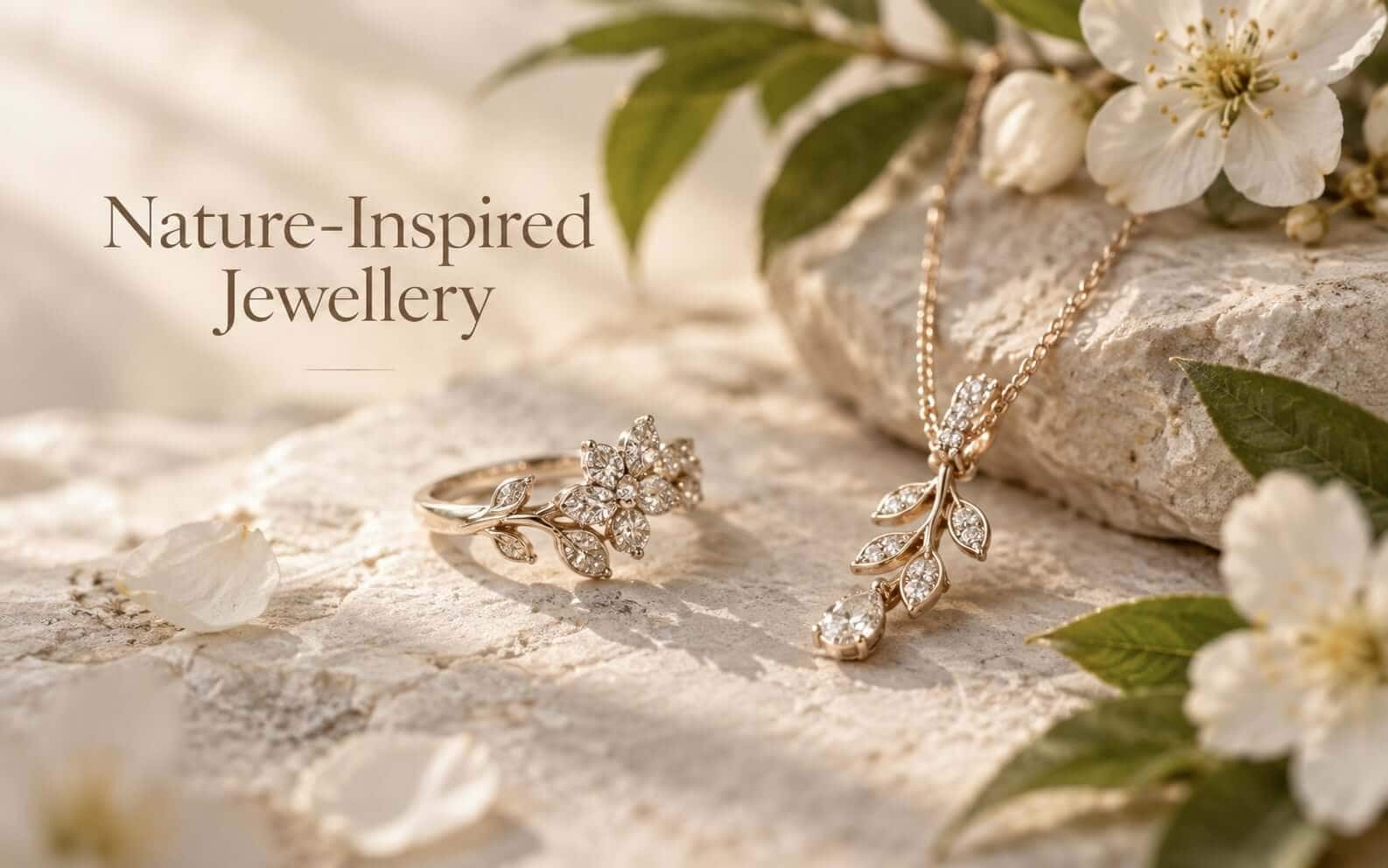

A small butterfly at the collarbone can be unmistakably itself. A curve of rose gold around a finger might suggest a stem, a current or nothing more specific than movement. Both can belong to the same jewellery language, even though only one asks to be recognised.
That is the pleasure of nature-inspired jewellery. It need not turn an outfit into a garden scene. Flowers, leaves and creatures are one route; rhythm, open space and the way a line seems to grow are another. The interesting choice is how directly you would like the reference to speak.
For some women, a recognisable motif carries a private association. For others, the appeal lies in a softer outline beside a sharply cut shirt or a simple dress. Neither approach is more sophisticated by definition. What matters is whether the design feels resolved, comfortable and convincingly yours.
Table Of Contents
- Start With The Shape, Not The Symbol
- Three Ways To Bring Nature Into Jewellery
- Let Open Space Do Some Of The Work
- Borrow The Movement, Not An Entire Period
- Style A Motif Without Building A Theme
- Check The Details That A Photograph Cannot Settle
- Choose A Reference You Can Live With
- A Little Nature, In Your Own Way
- Frequently Asked Questions
Start With The Shape, Not The Symbol
Before asking what a piece means, look at what it does. Does your eye travel around its edges? Is the centre open or filled? Do several small elements gather into one clear form, or compete for attention? These questions are more useful than deciding that all floral jewellery is romantic or that every butterfly must stand for transformation.
A recognisable motif can be graphic rather than sweet. A flower reduced to a few interlocking loops may sit quite naturally beside tailoring. An abstract design can be much more exuberant, with sweeping lines and diamonds covering almost every visible surface. Literal does not automatically mean ornate, and abstract does not automatically mean restrained.
Try describing the piece without naming its subject. You might call it compact, airy, curling, rounded or sharply outlined. That description often tells you more about how you will wear it than the label in the product title.
There is also a useful distinction between natural materials and nature-inspired design. Here, nature-inspired describes the appearance of the jewellery. It does not establish how its materials were sourced, whether a gemstone was treated or what environmental claims can be made about it. Those are separate questions requiring separate information.
Three Ways To Bring Nature Into Jewellery
The most direct approach is a recognisable subject: a butterfly with an open wing shape, a leaf or a flower. You do not need to hide the reference to make it elegant. Instead, judge the proportion of the whole piece and how much visual space the design leaves around its details.
A modestly scaled butterfly pendant, for example, can be worn as the only motif in an otherwise uncomplicated arrangement. It might sit above a plain neckline, accompanied by small diamond studs rather than another pair of butterflies. The reference stays clear without being repeated everywhere.
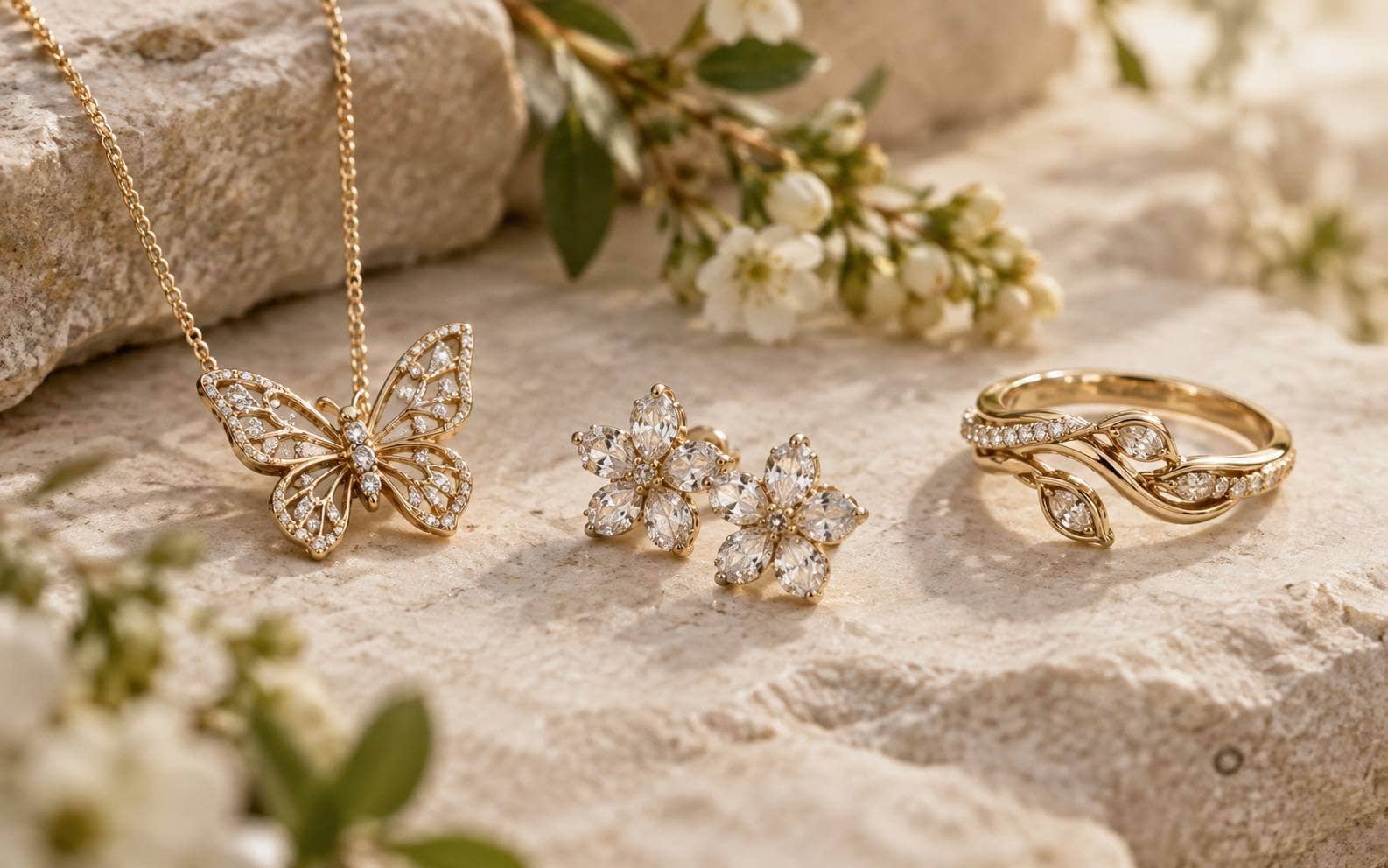
The pendant below offers that literal approach in an open, diamond-set outline. Its appeal is the recognisable shape, not a story that every wearer is obliged to share.

An Open Butterfly Outline
Diamond Butterfly Necklace Pendant 0.15ct G/SI Quality 18k White Gold
The recognisable butterfly shape is drawn in 18k white gold and 0.15ct of diamonds. An open outline gives the motif its character without filling the whole silhouette.
A second approach uses nature as a pattern. Repeated rounded forms can suggest petals without attempting a miniature botanical model. Look at the spaces between those forms as carefully as the diamonds themselves. Open centres can make a decorative design feel lighter, while a dense cluster gives it more visual weight.
The third approach is a suggestion of movement. Crossing bands, a tapering curve or an uneven sweep can recall something growing or flowing without depicting it. That association may come from the wearer rather than the designer. There is no need to claim an official botanical inspiration where the product description does not give one.
These are not three levels of good taste. They are three different degrees of recognition. Choosing between them is a matter of deciding whether you want to wear a subject, a pattern or a line.
Find The Line That Appeals To You
Compare an open pendant with a flowing ring, and notice which kind of detail feels most like your style.
Let Open Space Do Some Of The Work
A design is not made only of metal and stones. The gaps matter too. An opening inside a petal-shaped loop allows the background to become part of what you see. Against skin, that may give a soft, almost drawn outline. Against dark fabric, the same outline can become more assertive.
This is a useful way to compare two flower designs that initially seem similar. One might be a solid cluster with a scalloped edge. Another might rely on interlinked loops, with diamonds placed along only part of the structure. The first offers a concentrated patch of brightness; the second offers a more open pattern. Neither needs to imitate a real flower precisely.
The white-gold flower earrings below take that second route. Their interlinked rings make a flowery shape, with diamonds providing accents within the pattern. They are an example of how a familiar motif can be interpreted rather than copied.

Petals As A Pattern
Flower Diamond Earrings 0.20ct G/SI Quality 18k White Gold 10.2mm
Interlinked white-gold rings form the flower-shaped heads, with 0.20ct of diamonds across the pair. The stated 10.2mm head size describes the earring, not a single diamond.
Consider the background you are most likely to give the jewellery. Hair tucked behind the ear will show an earring's outline differently from loose hair partly covering it. A pendant over a textured knit may lose some of the clarity it has against a plain top. You are not looking for a universally correct setting, but the situation in which the design becomes easiest to enjoy.
Borrow The Movement, Not An Entire Period
Nature-inspired jewellery does not have to look antique. Nor does a curling line make a modern piece an Art Nouveau jewel. A historical reference is useful when it sharpens your eye, less useful when it supplies a grand identity the object has not earned.
The V&A's history of jewellery describes the sinuous, organic forms of Art Nouveau and their contrast with earlier floral motifs. It is a reminder that designers have interpreted the natural world in very different ways, not followed a single flower-and-leaf formula.
For a contemporary wardrobe, borrow an idea rather than a whole period. A curve might soften the line of a cuff. A repeated loop might echo the rounded buttons on a cardigan. An open motif might bring a little intricacy to a dress with otherwise clean lines. These are small visual relationships, not instructions to assemble a historical costume.
A crossover ring is particularly useful when you prefer the suggestion to the subject. The rose-gold example below has no named plant or creature. Its crossing bands simply provide the flowing movement discussed here. It is included as a related design, not presented as a documented botanical piece.

A Flowing Related Design
Pave Diamond Half Eternity Crossover Ring 0.50ct G/SI 18k Rose Gold
Crossing rose-gold bands and 0.50ct of pavé-set diamonds offer movement without a named botanical motif. This is a related design example, not a claim about the maker's inspiration.
You can take that distinction into any jewellery search. Look beyond the motif category and ask whether a piece has the kind of movement that attracts you. Sometimes the most satisfying nature reference is one that only you notice.
Style A Motif Without Building A Theme
An easy starting point is to give one detailed piece a plain background. A butterfly pendant can sit within the opening of a shirt. A pair of flower earrings can become the rounded counterpoint to a neat jacket. A flowing diamond ring can add interest to a hand otherwise wearing only a simple band.
This does not mean floral jewellery and patterned clothes are forbidden together. It means the relationship deserves a moment's attention. A small-scale print and an intricate pendant may merge from a distance. A larger, simpler motif could be clearer, or earrings might move the interest away from the patterned area altogether.
Repeat a quality rather than necessarily repeating the subject. Pair a rounded flower earring with a smooth curved ring, for instance, instead of requiring flowers on both. Or allow the same metal colour to connect two quite different pieces. The result can feel related without resembling a matched set chosen all at once.
Scale is another useful release valve. A small motif can be a quiet personal detail; a larger one may become the organising feature of the outfit. Try each with the clothes you already reach for. A striking jewel does not need an imaginary future wardrobe to justify it.
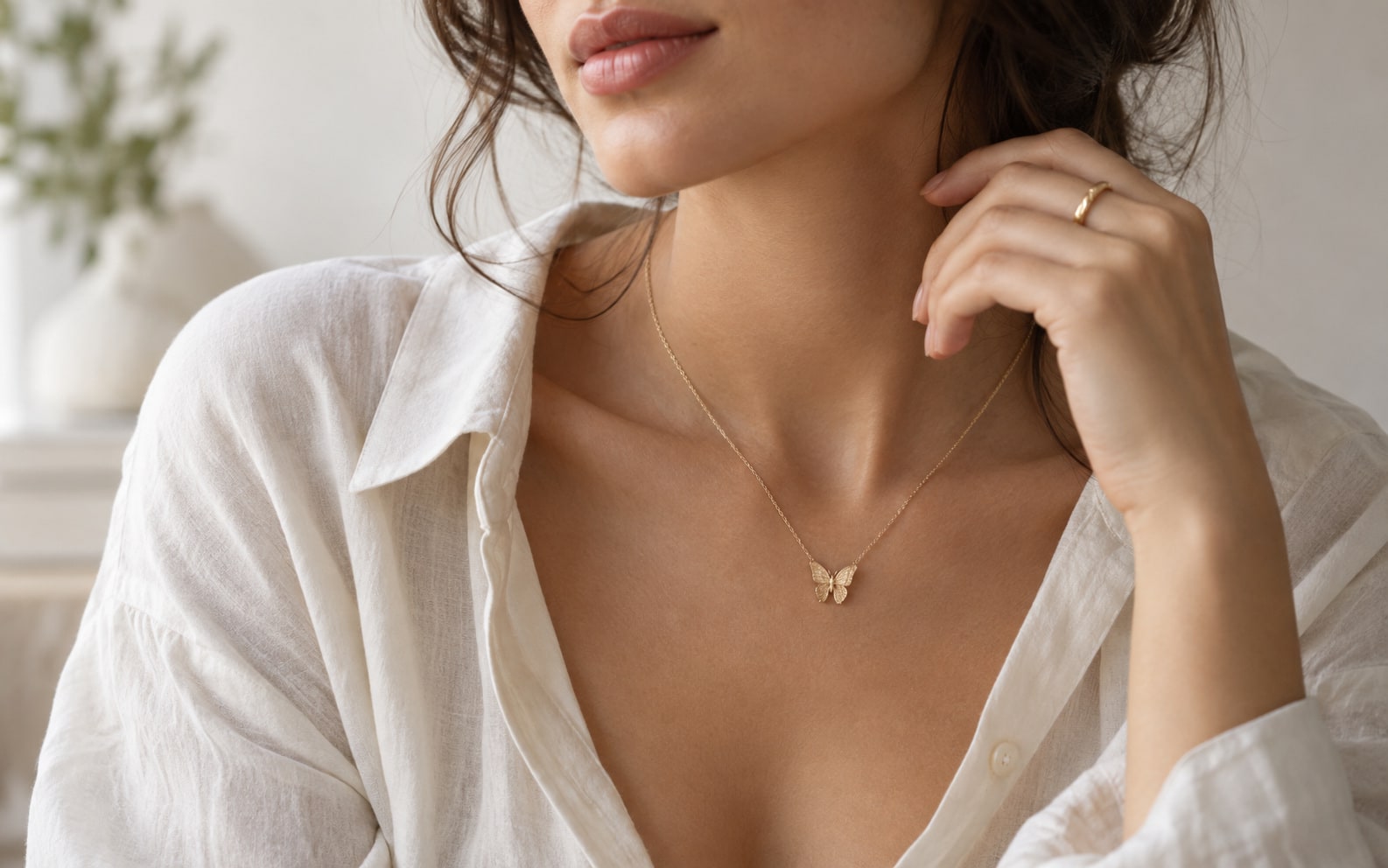
For an evening variation, change the background before adding more jewellery. A clean dark neckline can give an open white-gold design a sharper presence. A soft, unpatterned fabric can leave a rose-gold curve looking more distinct. The piece has not changed, but the way it is framed has.
And leave room for play. A motif you genuinely like can be worn with confidence without a defence of its sophistication. The purpose of this approach is to make choosing easier, not to police which flowers, creatures or colours an adult is allowed to enjoy.
Check The Details That A Photograph Cannot Settle
Once the design appeals, ask the practical questions that make it wearable. Request the overall dimensions, not only the stone weight. An airy shape may occupy more space than a compact design with more diamonds, so a carat figure alone does not describe the outline you will see.
For a pendant, establish whether the stated length includes the bail, the part through which the chain passes. Check what chain is included and where the pendant is likely to sit with the necklines you wear. For earrings, ask about the head size, profile and fastening. For a ring with crossing bands, ask how much of the design sits above the finger and whether another ring can sit beside it comfortably.
Openwork and small details deserve a look from more than one angle. A front photograph shows the design; side and rear views help you understand its construction. Rather than assuming a delicate-looking piece must be fragile, or a substantial-looking one must be trouble-free, ask how the settings and projecting details should be cared for.
Diamonds are highly scratch-resistant, but they are not immune to impact damage. The GIA diamond care guide distinguishes hardness from toughness, which is a useful reminder that the stones and the structure holding them both matter. Do not keep wearing a piece with a loose stone, bent detail or unreliable fastening while hoping the problem will settle itself.
Where coloured gemstones are involved, ask about treatments and follow advice for the particular piece. A general cleaning routine for plain diamond jewellery is not automatically suitable for everything in a mixed-gem design. All Diamond's broader guidance on keeping gemstones safe is a useful place to continue those questions.
Choose A Reference You Can Live With
The most personal nature-inspired jewellery need not be the most elaborate. A butterfly may remind you of a particular place. A flower may be appealing simply because you like the shape. A curling ring may have no fixed meaning at all and still become the piece that feels most like you.
There is room for symbolism, but it should be an invitation rather than an obligation. A guide to the meaning of jewellery symbols can open possibilities; it cannot decide what your own piece must mean. You are allowed to admire a form before attaching a story to it, or never attach one.
A useful final test is to imagine the piece on an ordinary day, without the product photograph's perfect lighting and carefully arranged background. Would you enjoy its outline? Would it work with the clothes you actually own? Would you still like it if nobody recognised the reference?
When those answers are yes, nature has already done enough. It has supplied a shape worth wearing, and left the rest of the story to you.
A Little Nature, In Your Own Way
Explore pendants and earrings for a recognisable motif, an open pattern or a detail you simply enjoy looking at. Let the design earn its place in the clothes you already wear.
Frequently Asked Questions
What Is Nature-Inspired Jewellery?
It is jewellery whose design recalls the natural world. The reference may be literal, such as a butterfly or flower, or more abstract, such as repeated petal-like shapes and flowing lines. The term describes design, not proof of sourcing or environmental performance.
Does Floral Jewellery Have To Look Vintage?
No. A simplified flower outline or an open pattern can work with contemporary clothes. Judge the scale, shape and amount of detail rather than assuming every floral motif belongs to a historical style.
How Can I Wear A Butterfly Pendant Without A Matching Set?
Make the pendant the main motif and connect other pieces through a quieter detail, such as metal colour or a curved outline. Small studs or a plain band can give the pendant room without repeating butterflies everywhere.
Is Every Crossover Ring Nature-Inspired?
No. Crossing bands may suggest movement to a wearer, but that does not establish the designer's intention. The crossover ring in this edit is a related example of flowing form, not a documented botanical design.
What Should I Check Before Buying An Openwork Design?
Ask about overall dimensions, side and rear views, settings and fastenings. Confirm the chain and pendant measurements where relevant. Openwork is a design feature, not enough information on its own to establish durability or comfort.